
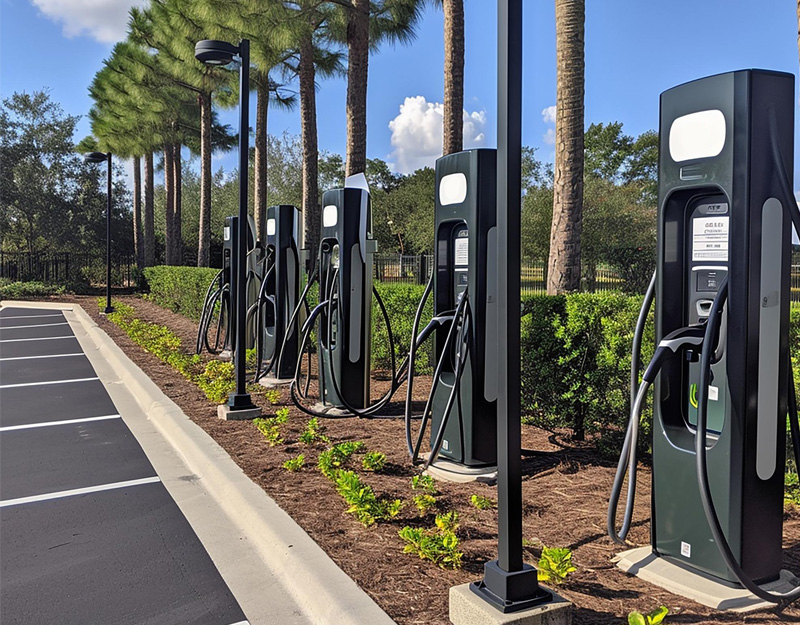
Choosing an EV charging station is not only about charging speed. Safe operation starts with the electrical setup, especially the circuit breaker. A good charger may still trip, overheat cables, or work unstably if the breaker does not match the charger capacity and site conditions. Before installation, review the panel capacity, supply type, cable size, and breaker rating. In this guide from Current Power, we explain how to choose the right breaker capacity and avoid common failures.
Why Is the Circuit Breaker Important in an EV Charging Station?
- The circuit breaker is the main protection point between the power source and the EV charging station. It disconnects current when there is an overload or fault that may damage the cables, panel, or charger.
- This matters because EV charging often runs for several hours. It is a continuous load, not a short-term use. When the breaker is selected correctly, charging becomes more stable, and the risk of tripping or overheating becomes lower.
- A suitable breaker protects the system, reduces faults, extends component life, and supports safer charging at home, work, or commercial parking areas.
How Does the Circuit Breaker Protect the Charging System?
- When an EV charging station is operating, the charger draws current based on its power rating and supply type. If the current exceeds the safe limit, or if a short circuit occurs, the breaker disconnects power before wider damage happens.
- Protection usually covers overload and short-circuit faults. Overload happens when the charger needs more current than the circuit can handle, or when it shares a circuit with other loads. A short circuit may result from wiring faults, damaged insulation, or a component issue.
- The breaker should work with proper earthing, residual current protection, suitable cable sizing, and the manufacturer’s instructions. This makes site inspection essential before choosing the charger or protection setup.
Factors That Determine the Right Breaker Capacity for a Charging Station
- There is no single breaker size for every EV charging station. The correct rating depends on charger power, supply type, voltage, cable route, site temperature, and panel capacity.
- A 7.4 kW charger differs from an 11 kW or 22 kW charger. DC chargers need a detailed study because their design and power requirements vary.
- Single-phase charging also differs from three-phase charging in current calculation and load distribution.
- Cable length should be reviewed carefully. A long distance between the panel and charger may require a more suitable cable to reduce voltage drop and heat buildup.
- The main panel must also support the added load. In sites with several chargers, load management helps distribute power and reduce pressure on the system.
How to Calculate Circuit Breaker Capacity Based on Charger Power
- The calculation starts by converting charger power into approximate current. Then the suitable breaker size is selected while considering continuous operation, cable size, panel capacity, and manufacturer instructions.
- For single-phase charging: Current = power in watts ÷ voltage
- For three-phase charging, the calculation depends on power, voltage, and power factor. Higher-capacity installations should be checked by a qualified electrician.
| Charger Power | Supply Type | Approximate Current | Indicative Breaker Size | Practical Note |
| 7.4 kW | Single phase | Around 32 A | 40 A | Common for home charging |
| 11 kW | Three phase | Around 16 A per phase | 20 A | Requires a three-phase supply |
| 22 kW | Three phase | Around 32 A per phase | 40 A | Suitable after load assessment |
| DC charger | Depends on design | Varies | Dedicated study | Not selected by a general number |
These values are indicative and do not replace a site inspection. The breaker must also match the cable. Increasing breaker capacity without the right cable can reduce protection instead of improving it.
Common Mistakes When Choosing a Breaker for EV Charging Stations
- A common mistake is choosing the breaker based only on charger power without calculating actual current or checking circuit capacity.
- Another mistake is connecting the EV charging station to a shared circuit, which may cause repeated tripping.
- Some users install a larger breaker to stop tripping. This may hide the real issue and allow current to pass beyond what the cable can safely handle.
- Other mistakes include ignoring cable length, failing to test earthing, neglecting residual current protection, or installing an outdoor charger without suitable protection from heat, moisture, and weather.
- If the charger trips often, do not replace the breaker immediately. Check the load, cable, wiring, charger settings, and panel capacity first.
Learn more from:Why Does Your Electric Vehicle Charger Stop Working Unexpectedly?
Risks of Using a Breaker That Is Too Small or Too Large
- A breaker that is too small usually causes repeated tripping during charging. This interrupts charging, delays the vehicle, and may make the user think the charger is faulty.
- A breaker that is too large can be more serious. If its rating is higher than what the cable or circuit can safely handle, it may not disconnect at the right time. This can cause cable overheating, insulation damage, and component failure.
- Proper protection comes from calculating the load, selecting the correct cable, checking the panel, and adjusting the EV charging station settings according to the actual site capacity.
Why the Breaker Must Match Approved Standards and Specifications
- An EV charging station handles high current for long periods, so protection components must match approved standards and installation requirements.
- This includes the breaker, cable, residual current protection, earthing, and installation method.
- Compliance means choosing a breaker suitable for the load type, matching it with cable size, following the manufacturer’s instructions, and testing the system after installation.
- In commercial sites, settings should be documented and inspected regularly, especially when more than one EV charging station is installed.
This step helps reduce faults, protect users, and support stable operation over the long term.
Tips to Keep an EV Charging Station Safe and Efficient
- Before installing an EV charging station, start by checking the site. This inspection identifies panel capacity, supply type, cable route, and required breaker size.
- Choose charger power based on daily use, not only the highest available speed. Also, make sure the vehicle can benefit from the charging capacity you plan to install.
- Use a dedicated circuit and avoid temporary extensions or unsuitable cables.
- After operation, watch for unusual heat in the breaker or panel, and request periodic inspection if the charger is used heavily or installed in a commercial site.
Read also: EV Chargers Installation Complete Guide for Homes and Businesses.
In locations with several charging points, smart chargers and load management systems help distribute power and reduce sudden disconnection. Current Power provides charging solutions that help you choose an EV charging station suitable for your site’s needs, while supporting safety, efficiency, and stable operation. A successful charging system needs the right charger, breaker, cable, and inspection. When the full system is compatible, charging becomes safer, more stable, and less likely to face failures.
Contact Current Power to choose the right EV charging station and prepare a reliable charging system that matches your location and daily usage.
FAQs
Only if the breaker, cable, and circuit are suitable for the charger capacity, and after the panel has been checked by a qualified electrician.
This may happen because the breaker is too small, the circuit has other loads, the cable is unsuitable, the wiring has a fault, or the charger setting is too high.
Not necessarily. A larger breaker may reduce protection if it does not match the cable and circuit. The correct solution starts with load calculation and site inspection.
Commercial charging is usually longer and more intensive, so commercial EV charging stations require load assessment, energy management, and suitable protection.