
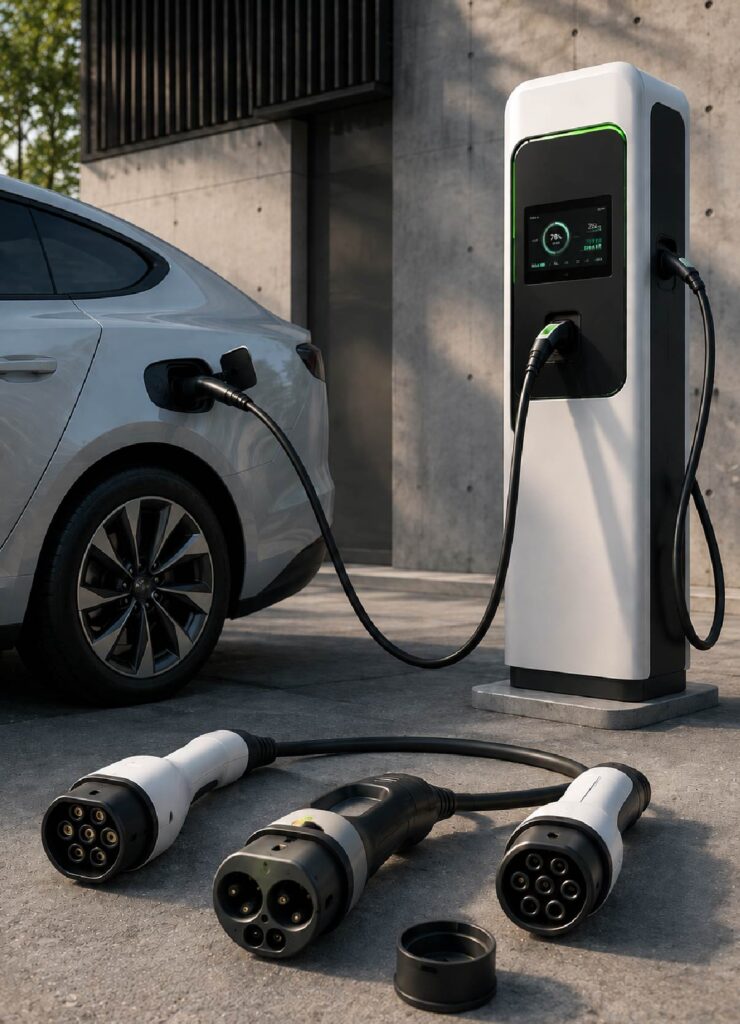
You can install a 22 kW charger and use a cable rated for the same power, yet still see the car charging at only 11 kW. The opposite can happen too: the vehicle may support a higher rate, while the charger or cable becomes the limiting factor. That is why electric vehicle charging cannot be understood from the charger rating alone. Actual charging speed depends on the charging point, the cable, the vehicle’s charging limit, and the electrical supply available at the site. The connector matters as well because it determines whether the vehicle and charging point can connect in the first place. This guide brings those parts together, explaining charging speeds, the main differences between charging cables, why Type 2 is so widely used, and how to choose a cable that matches what your car and charger can actually deliver.
Electric Vehicle Charging and How Charging Speeds Differ
- The easiest way to understand electric vehicle charging speed is to look at the complete charging chain. One component may support high power, but the session cannot run faster than the lowest limit in that chain.
- During AC charging, the charging point supplies AC power to the vehicle, where the onboard charger converts it into the DC power stored by the battery. This makes the vehicle’s onboard AC charging limit an important part of the final speed. With DC fast charging, conversion takes place in the charging station and DC power is supplied directly to the vehicle battery, allowing much higher charging rates.
- Consider a simple example. A charging point can supply 22 kW and the cable is also rated for 22 kW, but the vehicle accepts a maximum of 11 kW AC. The session will remain around 11 kW. Buying a higher-rated cable will not make that particular vehicle charge faster.
The main limits can be viewed this way:
| Factor | How It Affects Charging Speed |
| Charging point output | Sets the maximum power the station can supply |
| Vehicle charging limit | Sets how much power the vehicle can accept |
| Cable rating | Must support the required current and power |
| Single or three-phase supply | Affects the AC charging power available |
| Site electrical capacity | Determines what can be operated safely |
For everyday electric vehicle charging, matching these factors is more useful than simply selecting the highest number available.
Types of Electric Vehicle Charging Cables and Their Main Differences
- Electric vehicle charging cables do not all perform the same job. One of the most useful distinctions is where the cable connects and how it is intended to be used.
- A Mode 2 cable is commonly used to charge from a suitable electrical socket and includes an in-cable control and protection unit. MENNEKES describes Mode 2 as a mobile option for situations where a permanently installed charging station is unavailable, with some of its Mode 2 products providing up to 3.7 kW. This makes it useful as a portable or backup charging option rather than the first choice for regular daily charging.
- A Mode 3 cable connects an EV to a dedicated AC charging station or wallbox with a socket. Type 2 Mode 3 cables are available with different current and phase ratings, and suitable versions can support up to 22 kW at 32 A on three-phase power when both the vehicle and charging point support that rate.
- DC fast chargers work differently. Their high-power cables are generally attached to the charging station, so the driver does not select or carry them in the same way as a detachable AC cable.
- It is also useful to separate the terms cable and connector. The cable carries power between the two sides, while the connector defines the physical interface used at the vehicle or charging point.
Current Power, for example, offers a Type 2 to Type 2 AC cable rated up to 22 kW and 32 A, with several cable lengths available for different parking and installation requirements.
Type 2 Connector and Why It Is One of the Most Common Charging Connectors
- Type 2 has become one of the most widely used AC EV charging connectors and is the established standard across Europe. It can support single-phase or three-phase AC charging depending on the vehicle, charging point, and electrical installation.
- Type 2 interfaces are covered by the IEC 62196-2 standard for AC EV plugs, socket-outlets, connectors, and vehicle inlets.
- Part of its usefulness comes from the range of charging setups in which it can be used.
- A home wallbox may have a permanently attached Type 2 cable, while a public AC charging point may provide a socket and require the driver to carry a separate Type 2 cable.
- However, a Type 2 connection does not automatically mean 22 kW charging. The connector and cable may support that rating while the vehicle itself accepts only 7.4 or 11 kW AC.
- This distinction matters when buying a cable. If both the vehicle and charging point use Type 2, a Type 2 to Type 2 cable can provide the connection, but its current and phase rating still need to match the charging setup.
For a more detailed look at compatibility, read Current Power’s guide to Type 2 to Type 2 Charging Cable and whether it is suitable for all electric vehicles.
How to Choose the Right Electric Vehicle Charging Cable
Start with the vehicle and charging point rather than choosing a cable based only on price or the highest power printed on the specification.
Check the following:
- Vehicle connector: Confirm which AC charging connector the car uses.
- Vehicle AC charging limit: A car that accepts 11 kW will not charge at 22 kW simply because a 22 kW cable is connected.
- Charging point output: The station must support the required power and phase configuration.
- Cable current rating: Type 2 cables are available with different current and single or three-phase configurations, which affects how much power they can carry.
- Cable length: Choose a length that comfortably reaches the vehicle inlet without pulling or sharp bends. Current Power’s Type 2 cable is available in 5, 10, and 20 metre options.
- Build and protection: Consider where and how often the cable will be used, particularly for outdoor or shared charging locations.
These checks are even more important in commercial sites where one charging point may serve vehicles with different charging limits throughout the day.
The cable is also only one part of the installation. For the wider electrical requirements, read EV Charger Installation and the Most Important Technical Requirements Before Installation.
Tips to Improve Electric Vehicle Charging Efficiency and Reduce Charging Time
- Reducing electric vehicle charging time does not always require buying a more powerful charger. In many cases, the first step is finding what currently limits the session.
- Make sure the cable can carry the power supported by both the charger and the car. An underspecified cable can prevent the setup from using the available capacity, while a much higher cable rating adds no charging-speed benefit if the vehicle itself accepts less power.
- For regular daily use, a dedicated Mode 3 charging point is generally more suitable than relying continuously on a household socket and Mode 2 cable when the property’s electrical installation supports a dedicated charger. Mode 3 is designed around dedicated EV charging equipment and can provide higher AC charging rates.
- Inspect the cable and connectors regularly, especially when they are frequently used outdoors. Damage, contamination, or repeated mechanical strain around the connector should not be ignored.
- Avoid ordinary extension leads or improvised adapters to reach the vehicle. A correctly located charging point and an appropriately sized EV charging cable provide a better setup for repeated use.
- Most importantly, check the vehicle’s charging limit before trying to increase charging speed. Upgrading the charger or cable cannot force the car to accept more power than its charging system allows.
To conclude, efficient electric vehicle charging depends on the vehicle, charger, cable, connector, and electrical supply working together. Understanding the limit of each part makes it easier to identify what is holding charging speed back and avoids paying for capacity that the vehicle cannot use. Current Power provides integrated EV charging solutions covering charger and cable selection, site assessment, electrical preparation, and charging system installation for residential and commercial applications.
Contact Current Power to review your vehicle, charging requirements, and site capacity and choose a setup that makes better use of the power available.
Frequently Asked Questions
Charging speed depends on the charging point output, the vehicle’s charging limit, the cable rating, and the available electrical supply. The session cannot exceed the lowest limit among the relevant components.
Check the vehicle’s AC charging limit and the charging point output. If both support 22 kW three-phase charging, the cable should be rated accordingly. If the vehicle accepts only 11 kW, a 22 kW cable will not increase its charging rate.
Mode 2 allows charging from a suitable electrical socket through a cable with built-in control and protection. Mode 3 connects the vehicle to dedicated EV charging equipment and generally supports higher power for regular charging.
Type 2 is appropriate when both the vehicle and the AC charging equipment use the Type 2 interface. The cable must then be selected based on the current, number of phases, and required charging power.