
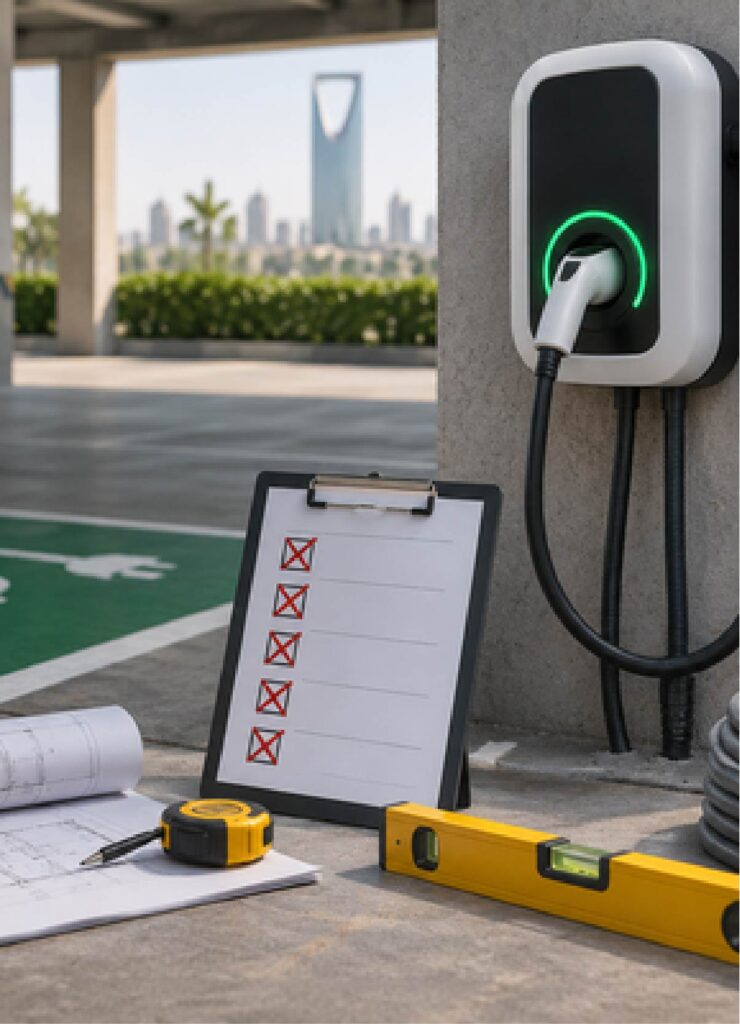
The finishing work is complete, and the charger has arrived. Then the installer discovers that the cable cannot carry the required load, or its route runs behind a newly finished wall. Suddenly, EV charger installation means reopening surfaces you have already paid to complete. These setbacks often trace back to early decisions. Here are seven common EV charger installation mistakes, their consequences, and how to avoid them.
Why Might EV Charger Installation Need to Be Redone?
EV charger installation starts before the unit is mounted, with an assessment of the supply, cable routes, protection, and charger position. Overlooking one element can mean replacing a distribution board or opening finished floors.
Saudi Electricity Company’s guidance on connecting EV charging systems to the grid addresses planning, design, technical evaluation, and connection procedures, depending on the project. This is particularly relevant to commercial and multi-charger sites.
7 Common EV Charger Installation Mistakes
Mistake 1: Buying the Charger Before Understanding How It Will Be Used
A homeowner buys a powerful charger, then discovers that neither the vehicle nor the property can support its full output. A busy car park faces the opposite risk: chargers too slow for vehicles that need to leave quickly.
Make the decision in the right order: Before committing to EV charger installation, establish how many vehicles will charge, how long they typically stay, the charging method they need, and the power each vehicle can accept. Compare these needs with the site’s capacity to avoid equipment changes and replacement wiring.
Read more: A complete guide to choosing EV chargers for fast, safe charging.
Mistake 2: Assuming a Spare Circuit Breaker Slot Means Spare Capacity
An empty breaker slot says little about supply capacity. Your EV charger installation may work until the air conditioning starts and the breaker trips. Charging places sustained demand on the building.
An effective EV charger installation assessment considers existing loads, the capacity of the supply and distribution board, and which systems are likely to operate at the same time. Limited capacity may call for slower charging, load management, or a supply upgrade. Address it before paying to modify the board later.
Mistake 3: Closing Walls and Floors Before Approving the Cable Route
Reopening a finished car park to replace wiring is expensive. During EV charger installation, this can happen when conduits are laid before cable size, route length, and installation method are confirmed.
Agree on a drawing that identifies the distribution board, charger position, and cable route before finishing works begin. For EV charger installation, a qualified specialist should also check cable sizing, voltage drop, and protection against the conditions along the route. If additional chargers are part of your longer-term plans, consider reserving a suitable route now. Planning now prevents repeat work later.
Mistake 4: Treating the Charger Like an Ordinary Power Socket
Protection requirements depend on the charger and circuit design. Poor earthing or unsuitable devices can interrupt charging and require electrical rework.
For EV charger installation, have a qualified professional specify the appropriate residual-current protection, consider DC leakage-current requirements in line with the charger’s specifications, and ensure that the circuit breaker is coordinated with the supply and cable. There is no single breaker rating suitable for every property or charger. You can also consult the EV charger and accessory model conformity certification program for information on equipment conformity.
Mistake 5: Choosing a Convenient-Looking Location That Does Not Work in Practice
The wall nearest the entrance looks ideal until the cable cannot reach a parked vehicle. Exposure to water, heat, or passing vehicles may also force you to relocate a new charger.
Think through daily use before finalizing EV charger installation. Check the vehicle’s charging-port position, approved cable length, parking direction, and space needed for access and maintenance. Select equipment with suitable environmental protection, and consider impact protection, shade, and drainage where the location requires them. A site inspection now can prevent relocation later.
Mistake 6: Leaving Connectivity and Load Management Until After Opening
A single home charger may not need advanced monitoring. A commercial car park is different: you need to track unit status, consumption, and the load created by simultaneous charging. Without early planning, expansion may require new wiring and controls.
That is why EV charger installation at multi-charger sites should include decisions about network connectivity, consumption monitoring, and load management from the outset. Where equipment and software are compatible, OCPP can support communication between chargers and central management platforms.
Current Power can help you select and manage charging solutions that serve your facility today while allowing for additional charging points in the future, without unnecessary changes to the underlying infrastructure.
Related reading: EV charging and the future of electric mobility infrastructure.
Mistake 7: Handing Over the Charger Before Completing Tests and Approvals
A successful first charging session does not prove that every connection and protective device has been tested. Hidden faults or missing documentation may delay safe operation.
Before signing off on EV charger installation, make sure you have:
- Results of the relevant earthing, insulation, protection, and supply checks.
- A functional charging test conducted according to the manufacturer’s instructions.
- As-built electrical drawings, test records, and the approvals applicable to your project.
For further guidance, consult the guidelines for connecting EV charging systems to the electricity network. Resolve outstanding findings before accepting the work.
Your Pre-Installation Approval Checklist
Bring this checklist to your contractor meeting before EV charger installation begins. Confirm each stage before proceeding.
| Project stage | What to confirm |
| Equipment selection | Vehicle charging capacity, parking duration, charging type, and connector compatibility |
| Electrical design | Existing demand, supply capacity, distribution board, and protective devices |
| Charger positioning | Mounting location, cable route, access clearances, and environmental protection |
| Future expansion | Spare cable routes, load distribution, and connectivity requirements |
| Handover | Test reports, operational demonstrations, drawings, and maintenance instructions |
This checklist does not replace engineering design. EV charger installation requirements differ between homes and commercial car parks; review the proposed scope with the engineer before approval.
What Should You Do If a Problem Appears After Installation?
Your EV charger installation is complete, but charging sessions start to fail. Before replacing equipment or reopening a cable route, identify the cause. It may be a software setting or network fault, or the wiring may need inspection.
If you notice abnormal heat, damaged components, or repeated interruptions, stop using the equipment and arrange an inspection by a qualified technician. Identifying a fault early can reduce the risk of further damage and avoid unnecessary repair costs.
To understand common warning signs, read EV charging stations and the causes of charger failures, which covers operational faults, overheating, and electrical connections.
Ready to take the next step? Assess your site before you order the charger or commission electrical work. Understanding the available power, choosing an appropriate charging capacity, and agreeing on cable routes will make EV charger installation more straightforward and help you avoid reopening finished areas. Current Power can support you with site assessments, load studies, charging system design, installation, testing, and maintenance, giving your project a clear route from planning to safe operation.
Contact Current Power to review your site’s readiness and determine what installation work is needed before you purchase equipment or begin finishing work.
Frequently Asked Questions About EV Charger Installation
Start with your charging needs and have a qualified professional assess the electrical loads and distribution board before selecting the charger and cable route.
A replacement may be necessary if tests identify unsuitable cable sizing, installation conditions, or excessive voltage drop for the intended charging load.
Discuss spare electrical capacity, cable routes, load management, and connectivity during design, before the site’s charging demand increases.
A clear EV charger installation handover includes as-built drawings, test results, operating settings, warranties, and required approvals.