
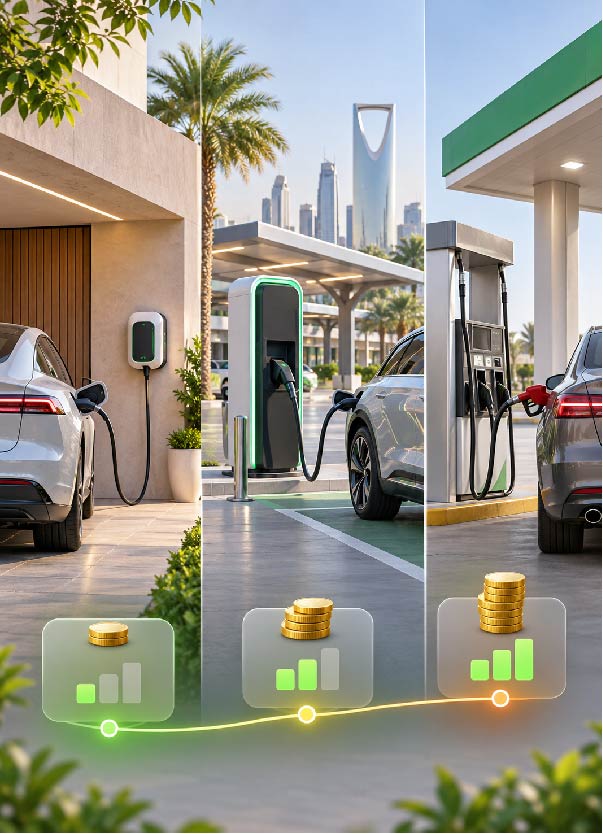
You may buy an electric car to spend less on fuel, only to find that ultra-fast charging on a journey costs more than petrol. At home, the same car charges for far less. The difference is the electricity price. To understand EV charging cost in Saudi Arabia, we compare prices per 100 kilometers and monthly expenses across home charging, public stations, and petrol, including the residential tariff change due in January 2027.
How to Calculate EV Charging Cost per 100 Kilometers
A car’s range tells you how far it may travel, not what the journey costs. Speed, air conditioning, and road conditions affect consumption. For a useful electric vehicle charging cost comparison, focus on the electricity you pay for.
Throughout, we assume an electric car needs 20 kWh of paid electricity per 100 km, while a petrol car uses 7 litres. These are illustrative figures, not measurements of specific models. We count electricity billed at the charger because some energy is lost before it reaches the battery.
To calculate EV charging cost, multiply billed kilowatt-hours by the price per kWh. For petrol, multiply liters by the litre price. Kilowatts (kW) describe charging power; kilowatt-hours (kWh) measure the energy billed.
Home EV Charging Cost: How Much Will Your Bill Increase?
Your car may sit outside your home from evening until morning. With a suitable charging space, you can use that time instead of visiting a station. Yet home EV charging cost depends on your household’s total consumption, including air conditioning and appliances.
Under Saudi Arabia’s current residential tariff, the first 6,000 kWh a month costs SAR 0.18/kWh, and consumption above that costs SAR 0.30/kWh. Our 20 kWh per 100 km therefore costs SAR 3.60 or SAR 6.00, respectively, before VAT.
Drive 1,500 km a month, and the car uses 300 kWh. If all this electricity falls within the first tier, your monthly EV charging cost is SAR 54 before VAT.
But if your household has already used 5,900 kWh, the first 100 kWh of car charging costs SAR 18, while the remaining 200 kWh costs SAR 60. That brings the total to SAR 78 before VAT, even though you drive the same distance.
From 1 January 2027, the revised residential tariff will set rates at SAR 0.21 and SAR 0.33/kWh. A circuit-breaker-based fixed charge will replace the meter-service charge. When calculating EV charging cost, do not attribute an existing household meter’s entire fixed charge to the car, but account for it if charging needs a separate meter.
EV Charging Cost at Public Stations: What Changes?
Charging on a long journey may cost far more than charging at home. Operators set different prices and may add fees. To assess EV charging cost, consider how far each paid kilowatt-hour takes you.
At a hypothetical SAR 1/kWh, charging our example car costs SAR 20 per 100 km, against SAR 3.60 at home in the lower tier, before VAT. This is an illustration, not an actual operator tariff.
A higher-powered charger may shorten your stop, depending on the car’s limits, battery condition, and charging conditions. Before plugging in, check the price, extra fees, and whether the time saved justifies the EV charging cost. See our guide to EV chargers.
EV Charging Cost vs. Petrol: A Comparison per 100 Kilometers
For every 100 km, we compare an electric car billed for 20 kWh with a petrol car using 7 litres. Public rates of SAR 0.65 and SAR 0.99/kWh are taken from EVIQ’s published prices solely as comparison references. Aramco’s October 2026 prices are SAR 2.18/liter for Petrol 91 and SAR 2.33/liter for Petrol 95.
| Charging or fuel option | Price per unit | Cost per 100 km |
| Home, lower tier | SAR 0.18/kWh | SAR 3.60 |
| Home, higher tier | SAR 0.30/kWh | SAR 6.00 |
| EVIQ fast charging, up to 50 kW | SAR 0.65/kWh | SAR 13.00 |
| EVIQ ultra-fast charging | SAR 0.99/kWh | SAR 19.80 |
| Petrol 91 | SAR 2.18/liter | SAR 15.26 |
| Petrol 95 | SAR 2.33/liter | SAR 16.31 |
Home EV charging cost is the lowest in this example. At SAR 0.65/kWh, public fast charging costs less than petrol 91, while the ultra-fast reference rate costs SAR 19.80 per 100 km, more than petrol. Different vehicle efficiencies can change the result.
Important: These are reference figures, not final bills. Home prices exclude VAT, while the published public prices do not clearly state whether VAT is included. Other fees may apply.
Monthly EV Charging Cost: Which Option Best Fits Your Driving Needs?
Return to 1,500 km a month. The electric car needs 300 kWh, which costs SAR 54 in the first home tier, SAR 195 at the EVIQ fast-charging reference rate, or SAR 297 at its ultra-fast rate. The petrol car, at 7 liters per 100 km, costs SAR 228.90 using Petrol 91.
If 80% of charging is at home (240 kWh) and 20% at the ultra-fast public reference rate (60 kWh), your energy total is SAR 102.60, before household electricity VAT and additional fees. The driving distance stays the same; the charging mix changes.
For the annual EV charging cost, include the charger and installation. Your site may need electrical board, cable route, and earthing checks, plus additional work. See our guides to installation requirements and home and business charger installation.
Start with your monthly mileage, how often you can charge at home, and what preparing your parking space will cost. These figures reflect your routine more accurately than a national average.
Start from the property you have, not the charger’s cost. Current Power assesses sites, reviews electrical loads, and installs chargers for homes and businesses.
Contact Current Power to identify a suitable charger before setting your installation budget.
Frequently Asked Questions About EV Charging Cost
Compare electricity billed over several charging sessions with the distance travelled. Your vehicle’s display or app can help; several journeys are more reliable than one.
The home rates in our examples exclude VAT. Adding 15% raises the first-tier cost of 20 kWh from SAR 3.60 to SAR 4.14, excluding other bill charges.
At 20 kWh per 100 km, the energy will cost SAR 4.20 in the lower tier or SAR 6.60 in the higher tier, before VAT. The new fixed charge is calculated separately according to the meter and circuit-breaker capacity.
It depends on consumption and price. Our ultra-fast reference rate costs SAR 19.80 per 100 km, against SAR 15.26 for Petrol 91. At SAR 0.65/kWh, the electric car costs SAR 13.00.