
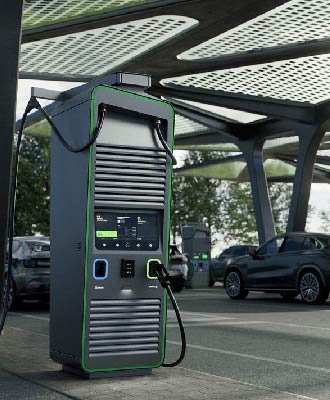
A fast-charging site can outgrow its original plan quickly. A location handling light traffic today may be serving twice as many EVs two years from now. The real question is not how much power you can install, but how much the site can use today and how easily it can grow later. That is where Alpitronic Hypercharger stands out, combining scalable power, efficient conversion, compact hardware, and flexible power distribution.
Alpitronic Hypercharger and the Technology Behind High-Power Charging
- Buying 400 kW on day one may sound future-proof. It can also mean paying for capacity the site barely uses during its first stage.
- Alpitronic takes a modular approach through its SiC power stack. HYC200 can be configured from 100 to 200 kW, while HYC400 can be configured from 100 to 400 kW. Supported configurations can be expanded later, allowing installed power to follow real demand.
- Alpitronic Hypercharger uses Silicon Carbide power electronics for AC-to-DC conversion, with HYC200 and HYC400 reaching efficiency levels of up to 97.5%. Alpitronic also reports 50% lower power losses compared with the IGBT technology used in earlier generations.
- At a busy station, that difference is repeated across every charging session. When a site moves large amounts of energy each day, better conversion efficiency becomes part of operating cost rather than a figure on the technical sheet.
- The all-in-one format also matters where space is valuable. At a service station or compact charging hub, a smaller footprint can leave more room for bays and vehicle movement.
For more on the infrastructure behind high-power charging, check this article: EV Charger Installation and the Most Important Technical Requirements Before Installation.
Alpitronic Hypercharger and EV Charging Speed
- Two EVs arrive together. One can accept around 180 kW. The second is further along its charging curve and is drawing much less. Giving both cars the same fixed share of power would not use the station as efficiently.
- Alpitronic Hypercharger can distribute power around the needs of active charging sessions. HYC200 delivers up to 200 kW and can serve two vehicles at the same time while HYC400 raises total output to 400 kW and gives higher-demand sites more room to allocate power between connected vehicles.
- For the operator, the useful measure is not the number printed on the charger. It is how many drivers can move through the site during busy periods.
- If one vehicle gets the energy it needs and leaves sooner, the bay becomes available to the next customer sooner. At a busy public site, that can improve charger utilization and reduce queues.
- Higher power still needs to match the vehicle mix. If most cars visiting the site are limited to lower DC rates, a 400 kW unit may spend much of its time below its potential. A site serving newer high-voltage vehicles or commercial fleets may justify a very different setup.
- Choose around the cars you expect, the traffic pattern, and dwell time. The maximum kW figure comes after those questions, not before them.
For a broader comparison, check this article: Electric Vehicle Chargers: A Complete Guide to Choosing the Best Chargers and Achieving Fast, Safe Charging.
Alpitronic Hypercharger and Charging Station Efficiency
Two sites can install chargers with the same headline power and still get different results. The difference often comes down to how well the equipment fits the site around it.
| Question for the project | What Hypercharger brings |
| What if traffic grows after launch? | Power-stack configurations can provide a route to higher installed power |
| What if vehicles need different charging rates? | Power can be allocated around active sessions |
| What if space is tight? | The all-in-one design keeps the equipment footprint compact |
| What about conversion losses? | HYC200 and HYC400 reach up to 97.5% efficiency |
| What happens when a charger needs attention? | Remote monitoring and diagnostics help teams respond faster |
| Can the unit be configured for the site? | Connector, cable, configuration, and branding options are available depending on setup |
This is the difference between buying a powerful Alpitronic charger and planning a station that can use that power well. A project may invest in grid capacity, civil work, transformers, and charging hardware. If the site rarely uses the capacity it paid for, the issue may be the original sizing rather than the charger.
Charger selection therefore belongs inside the commercial plan for the station. Traffic, energy demand, available space, and expansion plans should all shape the hardware decision.
For a better investment angle, check Cost to Install EV Charging Station: Factors, Permits, and Long-Term Returns.
Alpitronic Hypercharger Reliability and Performance
- One charger goes offline during the evening peak. The issue is no longer a technical fault on a screen. It is a queue, missed charging sessions, and drivers who may choose another station next time.
- Alpitronic supports the Hypercharger platform with remote diagnostics, software updates, service tools, hardware redundancies, and predictive-maintenance capabilities. Hyperservices adds remote and on-site support when the station needs intervention.
- Remote visibility gives the service team useful information before a technician reaches the site, helping narrow down the issue in advance.
- HYC200 also carries IP54 and IK10 ratings, supporting use in public and outdoor environments when the full installation is designed correctly.
- A reliable charger still depends on the site behind it. Grid capacity, cable sizing, earthing, protection, communications, and network stability all affect day-to-day performance. A strong Alpitronic EV charger connected to weak infrastructure will still create problems.
Current Power approaches those elements as one system, from load assessment and electrical preparation to charger installation, management-platform integration, and maintenance.
Alpitronic Hypercharger and the Future of Fast EV Charging
- The vehicles using a site today may not represent the same demand three or five years from now. More passenger EVs are moving toward higher charging rates, while electric commercial vehicles add another level of power demand.
- The Hypercharger range gives projects several ways to respond. HYC50 fits smaller or lighter-use sites. HYC200 and HYC400 move into higher-throughput locations. HYC1000 addresses a different class of project, with power held centrally and distributed across several charging points.
- The largest model is not automatically the best next step.
- A station may start with two HYC200 units and find that they cover early demand comfortably. When traffic grows, the next move could be more charging points, more grid capacity, a different equipment layout, or a higher-power architecture. What the site needs after growth matters more than simply moving to the next number in the range.
- The question then changes from “Which charger is fastest?” to “What is likely to limit this site when traffic doubles?”
For larger hubs and distributed power architecture, read HYC1000: Why It Stands Out as a Fast-Charging Solution for Electric Vehicles.
Alpitronic Hypercharger is strongest when the project needs more than high output. Scalable capacity, efficient conversion, compact hardware, power allocation, and remote service tools all support a site that has to perform now and adapt later. Choosing the right model starts with expected traffic, vehicle charging capability, available electrical capacity, and realistic plans for growth. Current Power provides Alpitronic solutions as part of complete EV charging projects, from site and load assessment to charger selection, electrical preparation, installation, and integration with charging management systems.
Contact Current Power to assess your site and choose an Alpitronic Hypercharger configuration that fits current operation without closing off future expansion.
Frequently Asked Questions About Alpitronic Hypercharger
Begin with expected traffic, the charging rates your customers’ vehicles can accept, and the electrical capacity available at the site. HYC400 offers more power, but that extra capacity only pays off when the site can use it.
If your station handles many vehicles every day, even a small loss is repeated across every charging session. Higher conversion efficiency can make a meaningful difference to operating performance over time.
Supported configurations can start closer to current demand and add installed power later. That lets expansion follow actual station use instead of paying for maximum capacity on day one.
Remote monitoring and diagnostics give the service team useful information before a site visit is required. Some issues can be identified or narrowed down sooner, helping reduce response time.
Highway charging, service stations, busy public charging hubs, commercial sites, and fleets are strong use cases when frequent DC charging and vehicle turnaround are important.