
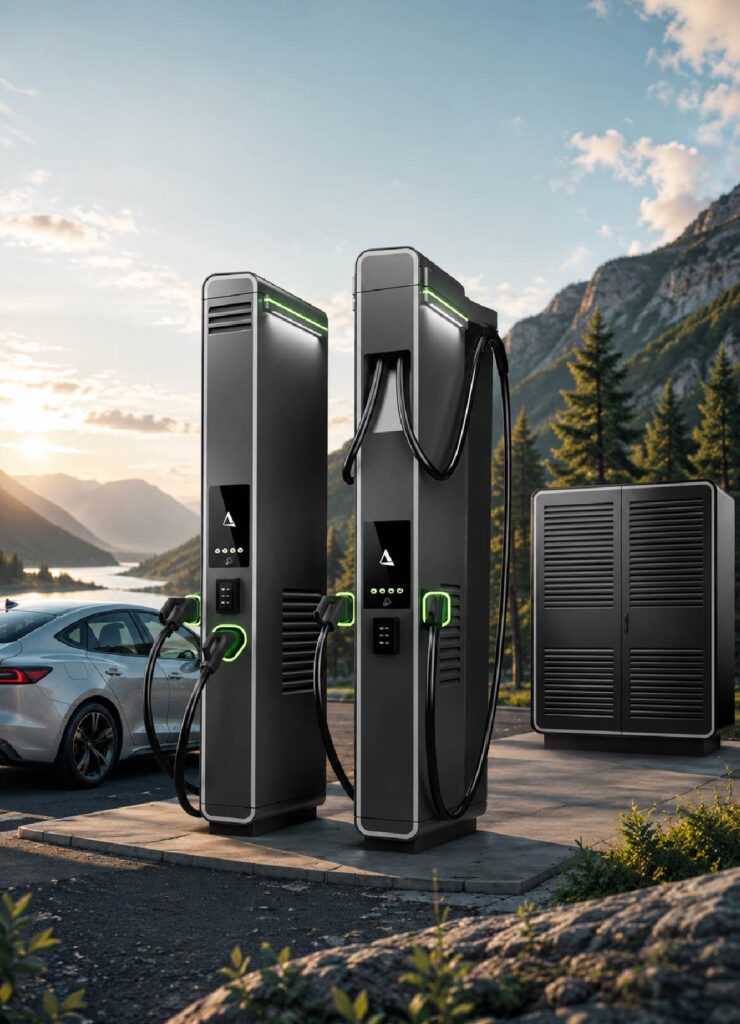
When planning a high-power EV charging station, what matters more: choosing the highest output, or using available power efficiently without installing more capacity than the project needs? This is where hyc1000 stands out from conventional fast-charging solutions. The system uses a central Power Cabinet that can deliver up to 1,000 kW, then distribute that power across several charging points according to the needs of each vehicle. This makes HYC1000 suitable for highway stations, large charging hubs, and projects serving passenger cars, commercial vehicles, or fleets. This guide explains how it works, how it can shorten charging time, and what to check before choosing it.
HYC1000 and How High-Power Charging Works
- HYC1000 uses a distributed setup that separates the main Power Cabinet from the charging points used by drivers. The power conversion equipment sits in one central cabinet, while dispensers can be positioned to suit vehicle flow and parking layout.
- The system can provide up to 1,000 kW in total and support up to eight DC charging points at the same time. The available power does not have to be split equally. HYC1000 can allocate it according to each charging session in 62.5 kW steps.
- This gives charging-station operators two practical advantages:
- Vehicles that can accept higher charging power can receive a larger share of the available capacity.
- Vehicles that need less power do not reserve capacity they cannot use.
- HYC1000 supports a voltage range from 150 to 1,000 V, allowing it to serve a wider range of current and high-voltage EVs. CCS2 and MCS options are also available depending on the project setup.
- A project therefore does not need eight separate power units for eight charging positions. One central cabinet can direct power across several dispensers, giving the site more flexibility in space and electrical planning.
How HYC1000 Can Reduce EV Charging Time
- A 1,000 kW system does not mean every vehicle connected to HYC1000 will charge at 1,000 kW. The vehicle determines how much power it can accept, while battery condition, state of charge, temperature, and the charging curve also affect charging speed.
- The benefit appears when a high-power vehicle reaches a site that can deliver the required capacity. In an IONITY deployment, HYC1000 charging points configured for up to 600 kW can add as much as 300 km of range in under eight minutes for compatible vehicles.
- Faster charging also affects vehicle turnover. If a vehicle needs less time to get enough energy for the next part of its journey, the station can complete more sessions during the day and reduce queues at busy times.
- Charging time should therefore be assessed against the vehicles expected to use the site, not the system’s maximum output alone.
Specifications That Make HYC1000 Suitable for Fast-Charging Stations
HYC1000 brings together features that are especially useful in large charging stations compared with a standalone fast charger.
| Feature | How It Reshapes Your Project |
| Up to 1,000 kW total capacity | Supports sites with high charging demand |
| Up to 8 DC outputs | Distributes power across several vehicles at the same time |
| 62.5 kW power allocation steps | Makes more precise use of available power |
| 150–1,000 V DC range | Supports vehicles with different voltage systems |
| CCS2 and MCS support depending on configuration | Can serve passenger cars and high-power commercial vehicles |
| Dynamic power management | Allocates power according to each charging session |
| OCPP 1.6J and 2.0.1 | Allows connection with charging management platforms |
| Remote diagnostics and updates | Makes monitoring and maintenance easier |
| IP54 and IK10 | Supports outdoor operation when installation requirements are met |
These features position HYC1000 as a system for a complete charging station, not simply a high-power charger.
HYC1000 Requirements for High-Power Charging Stations
Installing HYC1000 requires a wider infrastructure review than a home or medium-power DC charger. A site must first confirm that its electrical supply can support demand of this scale.
Before installation, review:
- Utility supply and transformer capacity.
- Expected peak load at the station, not just the charger rating.
- The location of the Power Cabinet and its distance from the charging points.
- Cable sizing, electrical protection, and earthing.
- Vehicle movement and parking layout.
- Load and energy management systems.
- Connection with the station management and monitoring platform.
- Future expansion and maintenance plans.
The distributed setup also gives more freedom in site planning. The Power Cabinet does not need to sit beside every vehicle, so dispensers can follow the parking layout and vehicle routes.
The project budget should also include electrical upgrades, transformer work, civil works, cabling, and digital management systems alongside the charging equipment itself.
For more on this part of the project, read: Cost to Install EV Charging Station: Factors, Permits, and Long-Term Returns.
The Role of HYC1000 in Supporting Electric Vehicle Fleets
For EV fleets, charging time affects daily operations. A delivery van or commercial vehicle left charging longer is unavailable for its next job, so charging speed directly affects use of the fleet.
HYC1000 can distribute power across several vehicles according to their schedules. A vehicle that needs to leave again soon may receive a higher charging rate, while another that will remain at the site for longer can charge at a lower rate.
This flexibility can serve:
- Delivery and logistics vehicles.
- Taxis and ride-hailing fleets.
- Electric trucks used on long-distance routes.
- Mixed fleets with different charging capabilities.
MCS support also gives the system greater ability to meet the needs of heavy commercial vehicles, particularly as electric trucks require much higher charging power than most passenger cars.
When HYC1000 Is the Right Choice for Commercial Projects
- Choosing HYC1000 depends on daily site traffic and the vehicles using the station. A project serving a high number of vehicles and aiming to reduce waiting times can benefit from the system’s high output and its ability to distribute power across several charging points.
- HYC1000 suits highway and intercity charging hubs, large stations, logistics centres, and busy fleet depots. It can also support projects preparing for electric truck charging or planning to add more charging points as demand grows.
- Smaller projects may need a different solution. If vehicles usually remain parked for three or four hours, medium-power AC or DC chargers may provide what the site needs at a cost that better matches actual use. The decision to install HYC1000 should come after reviewing vehicle numbers, parking time, electrical capacity, and the charging power the site really needs.
For a wider market perspective, read: The Future of Electric Cars in Saudi Arabia and the Role of Charging Infrastructure in Supporting Vision 2030.
Factors to Consider Before Choosing HYC1000
- Start with site data, not the product specification sheet. Look at the expected number of vehicles per hour, average parking time, the charging rates supported by those vehicles, and the busiest periods.
- Compare that demand with the electrical capacity available at the site. One project may need the full 1,000 kW, while another may be better served by a lower initial capacity with room to expand later.
- Review how many dispensers the site needs, which connector types suit the target vehicles, and whether MCS is required. The payment system, connection to the management platform, and maintenance plan should also be part of the decision.
- These details help show how much capacity the project will actually use and avoid paying for power that may remain underused.
In conclusion, HYC1000 should match the site’s traffic, vehicle mix, and available electrical capacity, not simply offer a high power rating. When these factors are assessed properly, the project can use power more effectively across several charging points, reduce waiting times, and build a station that can grow with demand. Current Power provides complete solutions for high-power charging projects, from electrical demand assessment and charging-point planning to infrastructure preparation, installation, and integration with charging management systems.
Contact Current Power to assess your project and determine whether HYC1000 fits your current charging needs and future expansion plans.
FAQs About HYC1000
HYC1000 uses one central Power Cabinet to distribute available power across several charging points, giving the project more flexibility in both power use and dispenser placement.
The system can support up to eight DC charging points at the same time. The actual power available to each vehicle depends on the site setup and the needs of the connected vehicles.
Vehicles that support high-power charging benefit most, particularly high-voltage EVs, electric trucks, and fleet vehicles where shorter charging stops can improve daily operations.
The required capacity should be based on vehicle traffic, supported charging rates, parking time, peak periods, and the electrical capacity available at the site.
MCS supports the higher charging power required by heavy commercial EVs, making HYC1000 useful for projects that plan to serve electric trucks alongside passenger vehicles.