
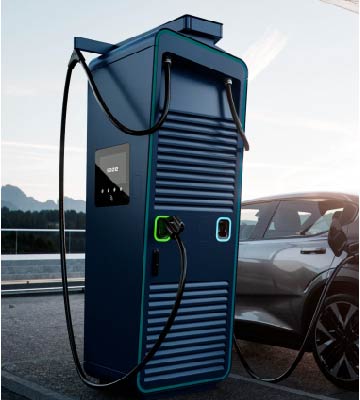
The success of a commercial EV charging station starts with choosing a charger that matches the site’s traffic, not simply choosing the highest available power. A location that receives many vehicles every day needs a charger that is fast, stable, and able to serve more users without creating constant pressure on the electrical infrastructure or a difficult experience for drivers.
For this reason, HYC 200 is a suitable solution for commercial projects that need reliable DC fast charging in high-traffic locations such as service stations, highways, shopping centers, hotels, and fleet sites. It combines high charging power, a compact design, and operating efficiency that can support a charging station as demand grows. This guide explains what makes Alpitronic HYC 200 suitable for commercial projects, how it improves station operation, and what should be checked before choosing and installing it.
What Makes HYC 200 Suitable for Commercial Projects?
- HYC 200 suits commercial projects because it is designed for locations that need faster charging than traditional wall chargers, along with stable operation during repeated daily use. In public charging stations, the user does not judge the service by charger availability alone.
- The experience also depends on how quickly the session starts, how long the driver waits, how clear the process is, and how stable charging remains until the session ends.
- The value of hyc 200 becomes clear in locations where the driver’s time is limited. A driver at a highway stop or shopping center does not want a long waiting time, and the site owner needs a charger that can serve more vehicles during operating hours. This makes charging power, energy management, and session flow essential parts of the project.
- This charger also suits projects that want to plan for growth. Its scalability from 100 kW to 200 kW allows a site to begin with a suitable setup and expand later as the number of users increases.
- However, HYC 200 should not be treated as a device separate from the project. Its success depends on site study, grid capacity, parking layout, vehicle entry and exit flow, charging management, and payment setup when needed.
Advantages of Alpitronic HYC 200 in Public Charging Stations.
The advantages of Alpitronic HYC 200 appear clearly in public charging stations because it combines speed, efficiency, and the ability to manage more than one charging session practically. This is important in sites that need to reduce waiting time and improve vehicle movement inside the station.
| Advantage | How It Supports a Commercial Charging Station |
| Up to 200 kW of power | Helps reduce charging time and serves drivers faster |
| Charging two vehicles at the same time | Improves site capacity during busy periods |
| Up to 97.5% efficiency | Reduces energy losses and supports operating efficiency |
| Compact design | Fits sites that need better space use |
| Scalability from 100 kW to 200 kW | Gives the project flexibility as demand grows |
| Dynamic load management | Helps distribute energy more steadily |
| Remote monitoring support | Makes it easier to track status and respond to faults |
These advantages make hyc 200 suitable for projects that treat charging as a continuous operating service, not just an added feature in the parking area. Drivers need a station that works reliably, while project owners need a charger that supports daily operation with fewer disruptions.
Read also: Cost to Install an EV Charging Station.
How HYC 200 Helps Increase Charging Station Operating Efficiency
- HYC 200 helps increase charging station efficiency by reducing session time and increasing the number of vehicles that can be served during the day.
- When the charger can deliver power that matches site demand, vehicle flow improves and congestion during peak hours becomes easier to manage.
- Operating efficiency appears in more than one way. First, high charging power helps drivers charge faster compared with lower-power chargers.
- Second, the ability to charge two vehicles at the same time helps the site make better use of one charging point.
- Third, dynamic load management helps distribute energy according to operating conditions instead of placing uncontrolled pressure on the electrical network.
- Commercial stations also need continuous monitoring. Remote monitoring and diagnostics help the operations team understand charger status, respond to faults faster, and reduce unnecessary site visits. This improves station availability and increases driver confidence in the location.
- This level of efficiency cannot be achieved by purchasing the charger alone. Transformer capacity, breakers, cables, earthing, and cable routes should be checked before installation.
- The parking layout around the charger should also be planned carefully so that poor vehicle movement does not reduce the value of the high charging power.
Sectors That Benefit from HYC 200.
Several sectors can benefit from Hyc 200, especially locations that need fast charging, continuous operation, and a high number of charging sessions during the day.
The main sectors include:
- Service stations and highways, where drivers need fast charging during a trip.
- Shopping centers and malls, where fast charging adds value to the visitor experience.
- Commercial fleets, where delivery or operational vehicles need to return to service quickly.
- Hotels and tourism facilities, where charging can support guest services.
- Large company parking areas, especially when employees and visitors use electric vehicles.
- Public charging stations, where the charger must handle repeated use and serve different users.
The benefit differs from one sector to another. A highway station usually focuses on charging speed and reducing waiting time. A shopping center may focus on offering a convenient service during the visit. Fleet sites often need clear scheduling and session management so vehicles can return to operation without delay.
Thus, speed alone is not enough. The charger should match the sector, vehicle parking duration, expected number of users, and the site’s available electrical capacity.
Tips for Choosing and Installing Alpitronic HYC 200 for Your Project.
- Before choosing Alpitronic HYC 200, start by studying the project from a daily operation perspective.
- Ask first: how many vehicles are expected to use the station every day? How long will drivers usually stay? Is the station public or for an internal fleet? Is there a plan to expand after one or two years?
- After that, the electrical infrastructure should be checked. This includes grid or transformer capacity, breaker size, cable size, earthing system, and cable route.
- A high-power charger such as the hyc 200 requires proper preparation to operate reliably and prevent repeated tripping.
- The installation location inside the site should also be studied. The charger should allow vehicles to enter and exit easily, with enough space for cables and user movement.
- In public locations, the project may also need to consider the user interface, payment method, lighting, directional signs, and connection to a charging management platform.
Learn more about site preparation from our article: EV Charger Installation and the Most Important Technical Requirements Before Installation.
To conclude, HYC 200 is a strong solution for commercial projects that need fast, stable, and scalable charging, especially in locations with high EV traffic. Its real value appears when it is selected after a proper study of usage volume, site capacity, and user experience. Current Power provides solutions that help you choose hyc 200 and prepare it safely and reliably according to your project and operating needs.
Contact Current Power to choose a suitable commercial charging solution and prepare a reliable charging station for your site.
FAQs About HYC 200
It is suitable for public charging stations and high-traffic locations because it supports DC fast charging and can serve more than one vehicle depending on the station setup.
It can be used in malls and shopping centers, especially when the site needs to serve visitors during short or medium parking times.
It needs a study covering grid capacity, transformer capacity, breakers, cables, earthing, and protection systems before installation.
It supports scalability from 100 kW to 200 kW, making it suitable for projects that expect higher future demand.