
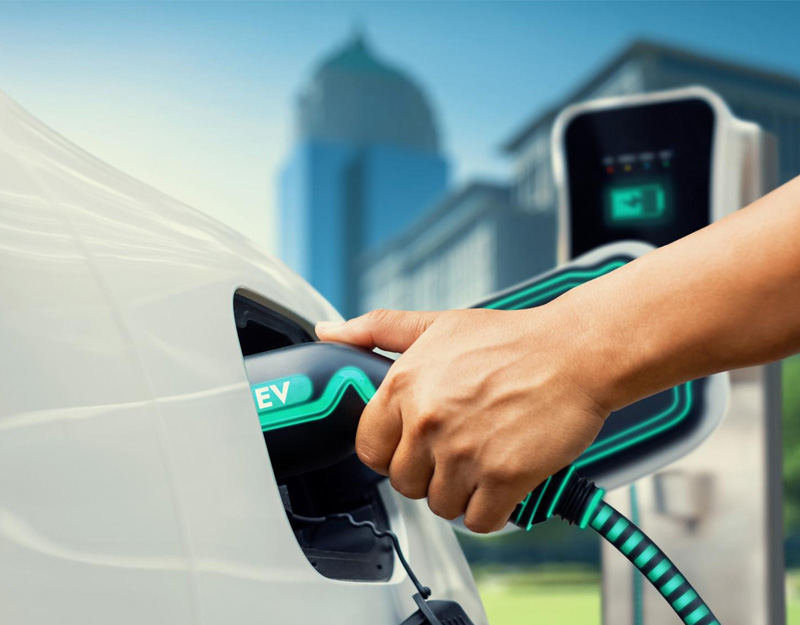
Do you want to turn charging your electric vehicle from a monthly bill into a real source of savings? In the era of the shift toward clean energy, charging has become a smart opportunity to manage and optimize costs.
So, how can you charge your electric car at the lowest possible operating cost? The secret lies in the golden timing, charging outside peak hours, and using smart charging technologies that protect the battery and reduce energy consumption. Through well-planned steps and simple habits, you can cut costs by up to half, extend your battery life, and make every charge an investment in sustainable savings.
First – Home Charging:
With the rapid growth of electric vehicles, home charging has become the cornerstone of a convenient and energy-efficient driving experience. It allows owners to charge their cars easily at home, with electricity costs that are relatively lower compared to public charging stations. By investing in smart home chargers (Level 2), higher efficiency and suitable charging speed for daily use can be achieved, reducing the need to rely on external stations and turning charging into a smooth, safe, and cost-effective experience in the long run.
Advantages of Home Charging for Electric Vehicles:
- Home charging is a practical solution, allowing you to charge your car while sleeping or during rest hours without needing to visit public charging stations.
- Home charging is the most economical option in the long run, as the cost is approximately one-third to one-quarter of the cost of gasoline for the same driving distance. It is also cost-effective during nighttime hours; taking advantage of off-peak hours (usually at night between 11:00 PM and 7:00 AM) means accessing lower energy rates. Many electricity providers offer Time-of-Use (TOU) tariffs, where the cost per kilowatt-hour drops significantly during periods of lower grid demand, often at night.
Advantages of Night-Time Home Charging for Electric Vehicles:
- Set your smart charger to start charging automatically when electricity tariffs drop.
- Wake up to a fully charged vehicle and a noticeably lower electricity bill.
- Imagine your EV charging cost being almost half of what you expected.
Home Battery Health:
Battery health decreases as it approaches a full charge.
It is recommended to stop charging when the battery reaches 80–90%, as this helps protect the battery and reduces charging costs, since charging efficiency drops as the battery nears full capacity.
How to Maintain Battery Health?
It is recommended to keep the charge level between 20% and 80% for daily use, and to reach 100% only when planning a long trip.
Second – Public Charging Stations:
What Are They?
Public EV charging stations are publicly accessible charging points located in parking areas, shopping malls, highways, and urban zones. They are designed to charge electric and hybrid vehicle batteries at different speeds. Unlike home charging, these stations are shared, paid for via apps or cards, and support connectors such as Type 2, CCS, or CHAdeMO. They allow drivers to charge while shopping or traveling, and many focus on solar-powered smart charging to reduce costs and rely on renewable energy.
Important Cost Facts You Should Know About Public Charging Stations:
Pricing is Different from Home Charging:
- Always more expensive than home: Public charging costs more than home charging (it can be 3–4 times higher).
- No fixed price: Prices vary from one network to another, from one station to another within the same network, and even by time of day (peak hours are more expensive).
You are not paying for electricity only (hidden fees):
- You may pay a session start fee (a fixed amount just for initiating the charging session).
- You may pay idle fees if you leave your car plugged in after charging is completed.
- Some networks require a monthly subscription to access reasonable prices.
Compatibility is a real issue:
Not all stations are compatible with all vehicles. Your vehicle’s connector type must match the station’s connector type.
Availability is not guaranteed:
The station may be occupied by other vehicles, out of service, or temporarily unavailable.
Tip: Always plan for an alternative charging station on your route and never rely on just one.
Location determines charging speed:
- Stations at shopping centers and restaurants are usually slow (suitable while eating or shopping).
- Highway and fuel-station chargers are usually fast (designed for travelers).
Pricing models at public charging stations:
- Time-based pricing (paying for the duration of the session).
- Energy-based pricing (paying per kilowatt-hour consumed).
Additional Fees at Public Charging Stations:
Peak-Time Fees:
The cost per kilowatt-hour may increase during peak hours (for example, in the evening).
Monthly or Annual Subscriptions:
- What are they: Fixed fees paid monthly or annually to join a specific charging network.
- Benefit: Networks usually offer subscribers discounted kWh rates or remove session fees, making subscriptions cost-effective for frequent users.
Idle Fees:
- What are they: Fees that start being applied after the vehicle finishes charging and a grace period (for example, 5–10 minutes) passes without unplugging.
- Purpose: To free up charging stations so more users can be served and to increase station utilization.
How to Avoid Paying Unnecessary Fees?
- Read the details carefully: Before using any station, always check prices and fees through the network’s app.
- Plan your charging: Try to charge at home whenever possible (usually the cheapest option), and use fast public chargers only when you really need a quick top-up.
Choose the right network for your usage:
- Casual or occasional user: “No-subscription” options may be suitable, even if they include a session fee.
- Frequent or regular user: A monthly subscription to one or two networks you use often can save you a lot in the long run, especially if it removes session fees and lowers the energy price.
- Unplug as soon as charging is complete: Avoid idle fees by enabling notifications in your vehicle’s app or the charging network’s app.
- Use aggregator apps: Apps like PlugShare or Electromaps help you compare total prices (energy + fees) between nearby stations before heading there.
- When using public charging stations, choose locations that offer free or low-cost parking, as long parking fees during charging can quickly turn into an expensive bill.
Third – Fast Charging at Public Stations:
Fast charging opens new horizons for electric vehicles, turning waiting time into minutes and making long-distance travel a practical, safe, and sustainable daily reality.
What is fast charging?
- It is the equivalent of a fast fuel station for electric vehicles.
- It fills your vehicle’s battery in a short time (minutes) compared to regular chargers (hours).
- It is mainly designed for long highway trips or when you need a quick charge in the city.
Important facts you should know about fast charging:
It affects battery life (in the long run):
- Frequent and heavy use of fast charging (for example, every day) can reduce battery lifespan over time.
It is not suitable for charging to 100%:
- Most vehicles charge quickly only up to around 80%, after which the speed drops significantly.
Price and power vary:
- Not all fast chargers are the same. Some are more powerful and faster than others.
Prices also vary by station and time.
It requires planning for trips:
- Plan the locations of charging stations along your route.
- Use map apps (such as Google Maps or EV apps) to know where to stop.
Fourth – Innovative Additional Cost-Saving Strategies:
Workplace charging: Charging stations provided by employers for staff, often free or heavily subsidized.
Using free “green charging”:
Some solar-powered charging stations in public areas (parks, government complexes) offer free charging as part of sustainability initiatives. Using home solar energy for charging further reduces electricity bills. Installing solar panels with a battery storage system can make EV charging nearly free in the long run, with a typical payback period of 5 to 8 years in many cases.
“Unlimited charging” subscriptions (for newer vehicles):
Some automakers offer new buyers a free limited-time subscription for fast charging on selected networks.
“Reverse peak-hour” programs with smart charging:
A special contract with the utility company that links your home to a smart charger, allowing charging when grid demand is low (from midnight until early morning).
Home charger sharing:
Using apps like PlugShare or ChargeHub to rent a neighbor’s or nearby private charger at a lower price than public stations.
Credit cards and charging rewards:
Some credit card companies offer extra cashback or bonus reward points on charging purchases from selected networks.
In Conclusion:
Charging an electric vehicle at the lowest possible cost is not a complicated secret, it is a set of smart habits built day by day. It starts with investing in a smart home charger, limiting daily charging to around 80%, planning trips in advance, and choosing public charging stations carefully and calmly. Always remember: every riyal saved on charging is a real step toward cleaner, quieter, and more economical electric mobility in the long run. Saving starts at the charging point.Get in touch with Electric car charging Current Power for a consultation.
FAQs:
1. Does charging at home at night really save money?
Yes, significantly. If electricity pricing in your area follows a Time-of-Use tariff, the cost per kilowatt-hour at night may be half of what it costs during peak hours.
2. Does fast charging harm my car’s battery?
Frequent fast charging can affect battery lifespan over time. It is recommended to use it only when necessary, such as for long trips.
3. How do I choose the best home charger?
Look for a Smart Charger that meets safety standards and allows remote control and scheduling. Also, make sure the charger’s power rating is suitable for your vehicle and your home’s electrical system.
4. How do EV map apps help reduce charging costs at public stations?
Using EV map apps helps you:
Plan long-distance trips.
Identify lower-cost charging stations along your route.
Avoid unnecessarily expensive stations.
5. How does vehicle maintenance affect battery efficiency?
Underinflated tires increase rolling resistance and reduce energy efficiency.
Maintaining correct tire pressure can save up to 3–4% in energy consumption.
6. How do vehicle loads affect the battery?
Reducing unnecessary loads in the car and using air conditioning reasonably helps lower energy consumption, especially in hot climates.