
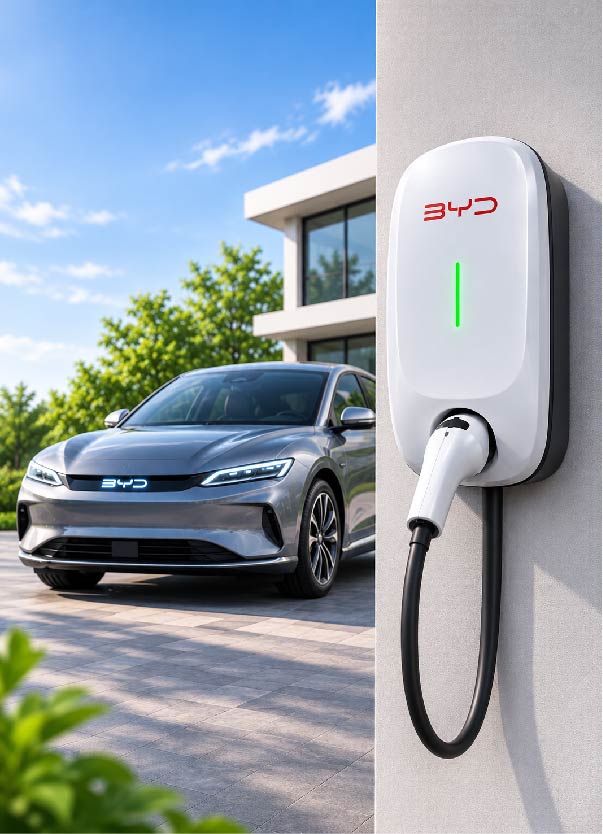
A 22 kW charger looks like a sensible investment until you discover your car can only accept 11 kW. If you are planning BYD charging in Saudi Arabia, begin with what your vehicle needs and what your property can deliver. The right setup should fit your routine, not just the specification sheet. Here is how to compare options, times, and costs before investing.
What Determines BYD Charging Requirements?
BYD charging varies by model, year, and whether the vehicle is fully electric or a plug-in hybrid. Check three figures:
- Battery capacity (kWh): The amount of energy the battery can store.
- Charger output (kW): The rate the charging equipment can supply.
- Vehicle charging limit (kW): The maximum power the car can accept.
A powerful charger saves no time if the car or electrical supply has a lower limit. Checking them first makes BYD charging more predictable and helps you avoid paying for capacity you cannot use.
Which Charger Suits Your BYD Charging Routine?
Start with parking time. BYD charging options depend on what your model supports:
- Home AC charging: A convenient fit for daily driving when the car can stay plugged in overnight.
- Workplace AC charging: Useful for employees and visitors parking for several hours; several chargers may require load management.
- DC fast charging: Better suited to journeys and shorter stops, although the car and battery conditions still govern the actual rate.
Before booking a public stop or purchasing equipment, confirm your car’s connector. Type 2 is used for AC and CCS2 for DC charging on models fitted with those standards. Imported vehicles can differ.
For more detail, see our guide to slow, fast and ultra-fast EV chargers.
How Long Does BYD Charging Take?
For BYD charging, published times are useful only when you know the model and test conditions. On BYD’s Saudi Arabia website, the ATTO 3 is listed as charging from 30% to 80% in 29 minutes with DC charging at up to 80 kW. The SEAL is listed at 26 minutes over the same range, with a maximum DC rate of 150 kW. Neither figure should be treated as a guaranteed BYD charging time at every station.
Home charging is easier to estimate. Divide the energy you need to add by the power the car can actually receive. To add 30 kWh, the theoretical time would be:
- 7 kW: About 4.3 hours.
- 11 kW: About 2.7 hours.
Actual BYD charging sessions may take longer because of energy losses and battery conditions. Check your model’s AC limit before spending more on a higher-rated unit.
What Does BYD Charging Cost in Saudi Arabia?
For home BYD charging, start with the electricity meter rather than the battery display. Multiply the energy drawn from the meter by your applicable tariff. The published Saudi residential electricity tariffs for November 2026 are SAR 0.18 per kWh for the first 6,000 kWh of monthly household consumption and SAR 0.30 per kWh above that level.
| Electricity drawn | At SAR 0.18/kWh | At SAR 0.30/kWh |
| 20 kWh | SAR 3.60 | SAR 6.00 |
| 30 kWh | SAR 5.40 | SAR 9.00 |
| 40 kWh | SAR 7.20 | SAR 12.00 |
Figures exclude taxes and other charges. Tariff tiers follow total household use; allow for losses if calculating from energy added to the battery.
Public BYD charging is priced by the station operator, sometimes with parking or session fees. Keep a record of a month’s use before comparing the cost of public charging with a home installation. Commercial properties must apply their own electricity tariff.
Preparing Your Property for Safe BYD Charging
Dedicated parking makes home BYD charging practical, but begin with a site assessment. Ask a qualified professional to check the supply, distribution board, circuit protection, earthing, and cable route. This determines what the property can safely support.
Current Power offers the Teltonika Energy TeltoCharge charger, with options up to 22 kW for residential and commercial use. Scheduled sessions, energy monitoring, and app-based controls can help you fit BYD charging around your day, subject to vehicle compatibility and available power.
Higher output is not automatically better. If your BYD accepts 11 kW AC, a 22 kW charger will not shorten the session. Compare your options in our home charger selection guide, then have the site assessed before making a purchase.
What to Check Before Public BYD Charging
Before leaving, check how much battery you have and the distance to your next destination. For public BYD charging, check:
- Whether a compatible charging point is available and working.
- Whether its connector matches your vehicle.
- Whether the station’s capacity suits your model’s charging limit.
- What you will pay, including any parking or session fees.
Follow the operator’s instructions, monitor progress in the app or on the charger, and stop the session correctly before disconnecting. If the charger displays a fault or repeatedly stops, contact support rather than bypassing its safety features.
Looking After the Battery During BYD Charging
Charging power often tapers as the battery approaches full capacity, particularly at DC stations. This is generally the vehicle managing charge level and temperature. For everyday BYD charging, follow the recommendations in your model’s manual and avoid extreme heat where practical.
Our guide to protecting an EV battery during charging explains the considerations in more detail.
When Does a Business Need a Dedicated Charging Setup?
A workplace or fleet needs more than an individual charging-time estimate. Effective BYD charging across a site depends on how many vehicles will plug in at once, how long they remain parked and how much electrical capacity is available alongside other building loads.
Load management can distribute available power and help track energy use. Current Power supports organizations with site assessments, charger selection, installation, management, and maintenance. Planning additional points early limits disruptive work later.
A good charging decision starts with your actual usage.
Once you know your car’s limits, likely charging hours and running costs, you can decide whether public stations are sufficient or a private charger makes sense. Current Power can help you evaluate the site and select, install, and maintain equipment suited to your property and future needs.
Get in touch with Current Power about a BYD charging solution that matches your vehicle and site, without paying for unnecessary capacity.
Frequently Asked Questions About BYD Charging
Check the owner’s manual or the official specifications for your exact model and year before selecting a charger or cable.
Battery temperature, state of charge, and the vehicle’s own limits can reduce the actual charging rate.
Estimate the energy you use in a week, divide it by your effective charging rate, and allow for charging losses.
Share the model, connector type, parking arrangements, distribution board location, and usual parking hours so the site can be assessed.