
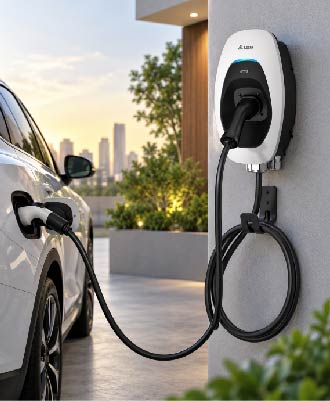
If your car stays in the garage from evening until morning, you do not need the highest charging power available. You need enough energy for the next day. AC Chargers suit that routine well: they charge while the car is already parked and can be installed in homes, offices, hotels, and commercial parking. The charging experience still depends on the vehicle, the electrical supply, parking time, and how power is managed at the site.
What Are AC Chargers, and How Do They Work?
When you plug in an EV, the battery does not receive AC power directly. AC Chargers supply alternating current to the vehicle, and the onboard charger inside the car converts it to DC before it reaches the battery.
A 22 kW charger may still show an 11 kW charging rate. If the vehicle accepts only 11 kW AC, charging stays at that level even when the charger can provide more.
The session follows three steps:
- The charger provides the power available at the site.
- The vehicle and charging point communicate to set the appropriate current.
- The onboard charger converts AC to DC for the battery.
For a car parked for several hours, AC charging uses that time to recover the energy used during the day without relying on fast charging.
To compare the main charging categories, read Electric Vehicle Charging Stations, Their Types, and Uses in Homes and Businesses.
AC Chargers and the Main Benefits for Electric Vehicles
You arrive home, plug in the car, and leave it until morning. AC Chargers suit this routine for several reasons:
- Use parking time: Homes, offices, hotels, and commercial parking give the vehicle enough time to charge gradually.
- Match daily driving: Most drivers do not need to refill the entire battery every night. They usually replace the energy used during the day.
- Manage site power: Some chargers support scheduling and load balancing, allowing charging power to follow the capacity available at the property.
- Track charging sessions: Smart models may show charging status, energy use, and scheduled charging times.
- Manage shared charging: Offices and commercial sites can use user access controls and central management when the selected charger supports them.
If your car stays parked for eight hours, there is little reason to force the session to finish in two. What matters is having enough charge before the next trip.
For more on AC charging power and charger selection, read: Electric Vehicle Chargers: A Complete Guide to Choosing the Best Chargers and Achieving Fast, Safe Charging.
Types of AC Chargers and the Difference Between Charging Powers
7.4, 11, or 22 kW? Start with the car and the electrical supply, not the charger’s highest rating.
A 7.4 kW charger commonly uses about 32 A on single-phase power. An 11 kW charger normally uses three-phase power at around 16 A per phase, while 22 kW typically uses around 32 A per phase.
| Power | Common supply | Suitable use | Check before choosing. |
| 7.4 kW | Single-phase | Homes where the car stays parked for hours | Vehicle limit and circuit capacity |
| 11 kW | Three-phase | Equipped homes or offices that need more AC power | Vehicle support and three-phase supply |
| 22 kW | Three-phase | Commercial parking or EVs that support 22 kW AC | Site capacity and on-board charger |
A 22 kW charger does not automatically charge faster than an 11 kW unit. If the vehicle supports only 11 kW AC, it cannot use the extra power available from a 22 kW charger.
Before choosing between AC chargers, check three things: the AC rate supported by the car, the electrical supply available at the site, and how long the vehicle usually stays parked.
For the electrical requirements behind these power levels, read EVCharger Installation and the Most Important Technical Requirements Before Installation.
AC Chargers for Homes, Offices, Commercial Sites, and Fleets
At Home
You arrive home in the evening and may not need the car again until morning. In many cases, several hours are enough for 7.4 or 11 kW charging.
AC chargers with scheduling or load management can also help organize charging around household electricity use. The right home charger should give the car the energy it needs within the available time without putting unnecessary pressure on the electrical system.
At the Office
Your car may sit in the office car park for six or eight hours. That is enough time to add a useful amount of energy before the end of the working day.
For offices, AC chargers can serve employees and visitors without installing fast DC charging at every space. If several vehicles charge at once, managing the available power can matter more than increasing the output of every charger.
At Hotels, Retail Sites, and Shared Parking
Guests and visitors already spend time at the property, so they can charge during their stay. Several AC points can serve different vehicles throughout the day, while load management or central control can help distribute the available power.
For Fleets Returning to Base
If fleet vehicles return to the same depot in the evening and stay there overnight, those hours can be used for AC charging before the next shift.
This suits fleets that do not need vehicles back on the road quickly. Short turnaround times may call for higher charging power.
To compare home charging options, read: Best Home EV Charger in 2026: Top 7 Options You Should Consider.
How to Choose the Right AC Chargers for Your Electric Vehicle
Before buying a charger, check the AC power your vehicle can accept, then make sure the site can provide it.
Use these points before choosing:
- Vehicle AC charging limit: Check the on-board charger specification.
- Electrical supply: Confirm whether the site has single-phase or three-phase power and how much capacity is available.
- Parking time: A car parked for ten hours does not have the same charging need as one leaving after two.
- Daily energy use: Focus on the energy you normally need to replace, not only the full battery capacity.
- Number of vehicles: With several cars, load management may be more useful than raising the power of every point.
- Connector type: Check that the vehicle inlet and charging cable are compatible, including Type 2 where required.
- Smart features: Scheduling, energy monitoring, user control, and central management can be useful for homes and shared sites.
- Site readiness: Breakers, cables, protection, earthing, and distance from the distribution board affect both installation and charger power.
In conclusion, choosing AC chargers starts with the vehicle, the time it stays parked, and the electrical setup at the site. Current Power provides AC charging consultation and solutions for homes and commercial sites, from charger selection to installation and commissioning.
Contact Current Power to choose an AC charger that suits your vehicle and site.
Frequently Asked Questions About AC Chargers
With AC charging, alternating current reaches the vehicle first, and the onboard charger converts it to DC before it reaches the battery. DC chargers perform the conversion inside the charging station and send DC power to the vehicle.
Charging speed depends on charger power, the maximum AC rate supported by the vehicle’s onboard charger, and the electrical capacity available at the site.
Charging time depends on battery size, starting charge level, and the power the vehicle can use. Some sessions take several hours, which is why overnight charging suits many AC applications.
11 and 22 kW AC charging are commonly used with three-phase supply, while 7.4 kW can operate on single-phase power when the circuit and electrical installation are suitable.