
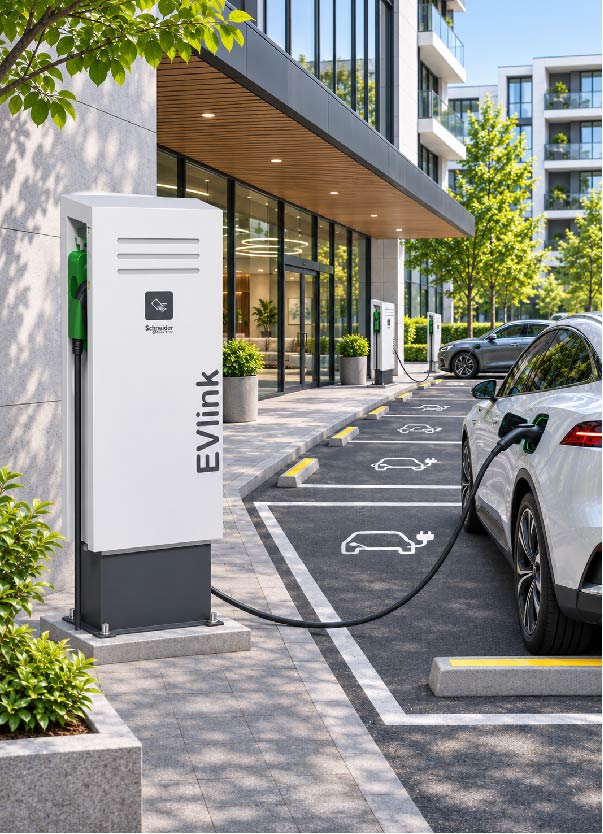
Why install a two-point charging station if your building cannot power both points at once, or if unauthorized drivers occupy them? Consider these concerns before purchasing Schneider Electric EVlink Parking, particularly for parking areas shared by staff and visitors. You need to know how much power the station can deliver, how access is controlled, and what installation work your building requires. This article explains what to check before buying so you can provide a useful charging service without unexpected costs.
What Is Schneider Electric EVlink, and Why Does It Suit Commercial Parking Facilities?
Schneider Electric EVlink Parking is an AC charging station intended for commercial buildings and shared parking facilities. Certain models have two charging points in one unit, with options to manage access and monitor charging sessions.
Consider an office building: an employee parks for the working day, while a visitor may charge during a meeting. AC charging makes use of the hours vehicles already spend on site, without requiring a DC fast charger at every parking space.
Still, two charging points do not settle how the service should operate. Decide who can charge, whether the service is free or paid, and how many cars may need charging simultaneously. Those answers will influence the model and its settings.
For the differences between AC destination charging and DC rapid charging, read our guide to EV charging station types and uses.
EV Charging Station Specifications and Key Technical Features
When assessing Schneider Electric EVlink, check the output of each point and how the two operate together. Current Power offers EVlink Parking with up to 22 kW per charging point and two connections in one unit. Specifications vary across models, so confirm the exact reference before ordering.
| Feature | Benefit for your parking facility |
| Two points on selected models | Two vehicles can charge from one unit |
| Up to 22 kW per point | Maximum rated power, not a guaranteed rate for every vehicle |
| RFID reader on selected models | Restricts charging to approved users |
| OCPP on supported models | Connects session data and status to a compatible platform |
| Energy management options | Helps control charging within the installed system’s power limits |
What happens when two cars are connected at once?
Even with a 22 kW rating, each car’s onboard AC charger may limit the power it receives. Available building capacity and load-management settings can impose further limits. Ask your supplier about the power available at each point during simultaneous charging, rather than relying on the highest advertised figure.
RFID readers, Type 2 sockets, and connectivity also depend on the model. See Schneider Electric’s EVF2S22P44R product page for one configuration.
Schneider Electric EVlink Installation Requirements for Buildings and Complexes
You may find the ideal parking space for the charger, then discover that air conditioning, lifts, and lighting already consume much of the building’s available power. Before installing Schneider Electric EVlink, ask a qualified installer to assess the remaining capacity and any changes needed to the distribution board.
Have the contractor check:
- Electrical supply: How much capacity remains after existing building loads?
- Protection and wiring: Do breakers, cables, and earthing meet the selected model’s installation requirements?
- Parking layout: Can vehicles reach the socket without cables crossing pedestrian or vehicle routes?
- Outdoor exposure: Are the enclosure rating and mounting suitable for sunlight, dust, and rain?
- Connectivity: Is a suitable network available for remote monitoring or user management, if required?
If you expect to add chargers later, tell the installer beforehand. Planning cable routes and distribution-board space for expansion, after checking the site’s capacity, could spare you costly rewiring.
Read more in our article on EV charger installation and electrical preparation.
Managing Charging and Access in Shared Parking Facilities
You may want to protect the charger from unauthorised use or reserve it for employees. Some Schneider Electric EVlink models allow you to approve users through RFID cards, preventing others from starting a session.
The arrangements depend on the facility:
- Employee parking: Assign RFID cards where a suitable reader is fitted, and confirm how to deactivate a lost card.
- Shopping center parking: For paid charging, ensure the connected platform supports pricing and payments. An electricity meter alone is not a billing system.
- Parking across several buildings: Confirm that the stations and chosen platform can provide a central view of charger status and completed sessions.
Certain EVlink Parking models support OCPP 1.6 for communication with management systems. However, protocol support does not guarantee that every platform function will work automatically. Ask your supplier to demonstrate the required integration before handover.
For more on compatibility, read Open Charge Point Protocol and EV charging.
Why Consider Schneider Electric EVlink for Buildings in Saudi Arabia?
If you manage offices, you probably see employees’ cars parked for hours each day. Offering AC charging during this time can make better use of those spaces. Schneider Electric EVlink Parking is worth considering, especially where a two-point model can serve two vehicles without separate charging units.
Access control is also useful when employees share parking with visitors. An RFID-equipped model can restrict charging to authorized drivers. With a compatible management platform, you may monitor usage and assess when more charging points are needed.
Before purchasing, check that your building’s electrical supply can support the installation. Confirm the selected model’s management functions and ask about warranty coverage, spare parts, maintenance, and technical support in Saudi Arabia. These details matter once the service becomes part of everyday building operations.
To compare AC charging capacities, see our electric vehicle charger selection guide.
Make the decision around your parking facility. Before ordering Schneider Electric EVlink, review how long vehicles stay, confirm the model, available output, connection requirements, and local support. Current Power offers site assessment, charger selection, installation, and commissioning services.
Contact Current Power to request a parking-facility assessment and identify the station and electrical preparations your building needs.
Frequently Asked Questions About Schneider Electric EVlink
Schneider Electric states that a replacement administrator RFID card can be created for certain EVLink parking models using its Commissioning Tool. Contact the technician responsible for the station and store access details securely.
A red indicator may signal a fault that makes a charging point unavailable. Its meaning depends on the model and light pattern. Consult the troubleshooting guide and fault code, and have persistent faults investigated.
Check the charger’s socket, your vehicle’s charging inlet, and the cable you will use. Some EVlink Parking versions have Type 2 sockets, but connector configurations vary by model.
Ask for the model reference, warranty documents, and confirmation of parts and technical support in Saudi Arabia. Check available replacements and whether management settings can be transferred to another model.