
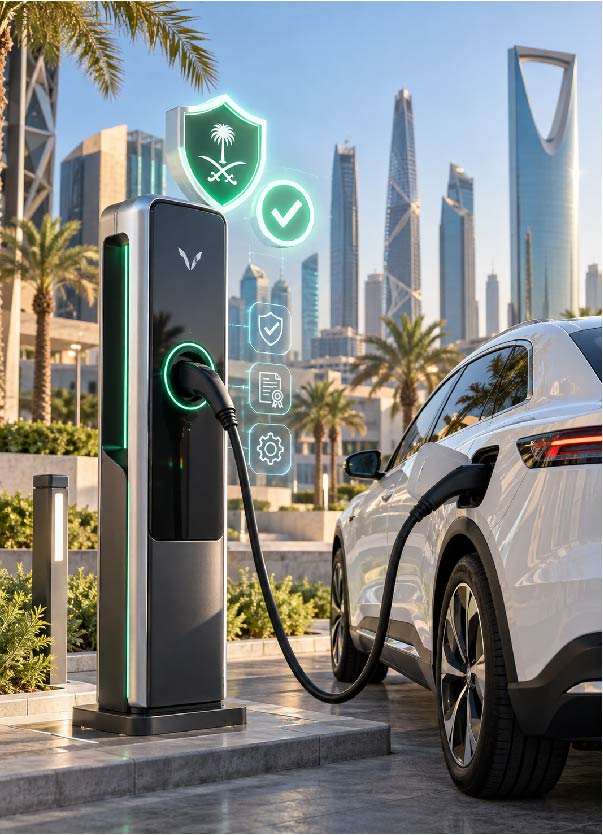
You are preparing an EV charging site near a busy shopping centre or along a highway, where several drivers may need to charge throughout the day. A Volt Charging Station may catch your attention with its high charging power and ability to serve two vehicles at once. Before placing an order, however, you need to check something beyond the specifications: the Saudi Standards, Metrology and Quality Organization (SASO) requirements. Which documents should your supplier provide, and how can you confirm that the model you are buying meets the requirements for your project in Saudi Arabia?
What Does SASO Compliance Mean for a Volt Charging Station?
Before buying a Volt charging station for your site in Saudi Arabia, ask for the conformity documents covering the exact model you intend to install.
The Saudi Standards, Metrology and Quality Organization (SASO) provides a conformity certification service for electric vehicle chargers and accessories. Its requirements include safety and electromagnetic compatibility (EMC) test reports, technical drawings, risk assessment documents, and information about the product and its intended operation.
Why should this matter to you as a station owner?
Safety testing examines the charger against applicable electrical safety requirements. EMC testing checks whether its electromagnetic emissions and resistance to interference meet the relevant limits.
These checks concern the equipment you are purchasing, so the model number and technical details must match the documents supplied.
Which Volt Charging Station Specifications Should You Check Before Buying?
Suppose your site receives a steady flow of drivers who only stop long enough to charge before continuing their journeys. You may need a charger that serves more than one vehicle, without making drivers wait for a charging point to become available.
Current Power offers the Volt Charge Premium 120–180 kW DC Charger, intended for busy charging locations such as highway stops and large shopping centres.
According to the product page, its main features include:
- 120–180 kW DC charging power: Suitable for sites where drivers need faster charging during relatively short stops.
- Dual-Gun system: Allows two vehicles to connect and charge at the same time.
- Dynamic power distribution: Shares the available charging power between the two outlets according to the system’s operation.
- Wide voltage range: Supports a range of modern electric vehicles, although vehicle and connector compatibility should still be checked before installation.
There is one detail worth asking about before you buy. Two charging outlets do not mean that both cars receive the station’s full rated power at the same time. The available power is shared between charging sessions, and each vehicle can accept only the power its charging system allows.
You should also separate the product specifications from its regulatory documents. A technical description does not replace a conformity certificate or the required test reports.
If you are still comparing DC charging capacities, our article DC Fast Charger for Electric Vehicles: Features, Uses, and Selection Guide explains the other factors that affect power selection, including vehicle demand and the electrical capacity of your site.
How Can You Check the Conformity Documents for a Volt Charging Station?
Ask your supplier for the technical file before confirming your purchase. It is much easier to clarify a missing report or an incorrect model number at this stage than after the charging equipment has arrived and installation work has begun.
SASO identifies several documents required for the conformity certification process. Here is what you should review:
| Document | What should you check? |
| Model conformity certificate | Model name and number, certificate scope, and validity |
| Safety test report | Whether the report covers the model being supplied and meets the applicable laboratory requirements |
| EMC test report | Whether the charger has been assessed against the relevant electromagnetic compatibility requirements |
| Risk assessment | Identified product risks and the measures taken to address them |
| Technical drawings and specifications | Whether the drawings and technical details match the equipment being supplied |
| User manual and product labels | Operating instructions, warnings, manufacturer details, and model identification |
Read the documents together rather than checking only whether a certificate is attached. The details on the charger, its technical file, and the conformity documentation should all refer to the model you are buying.
What if the model number on the certificate is different from the charger offered to you?
You may find a charger that suits your project, then notice that the model number on the certificate does not match the unit being offered. Do not assume that similar product names mean the certificate covers both.
Ask the supplier to explain the difference and provide evidence that the certificate covers the exact charger you intend to purchase.
The same care is needed with international test reports and certificates. They may provide useful technical evidence, but they do not automatically prove that SASO has issued the required conformity certificate for that model.
Review the certificate and supporting documents before placing your order. You do not want to discover that important compliance paperwork is missing when your installation is already underway.
Is Product Conformity Enough to Start Operating a Charging Station in Saudi Arabia?
You might select a charger, review its conformity documents, and be ready to proceed, only to discover that the electrical supply at your location needs upgrading.
For example, if you plan to install a high-power Volt Charging Station at a shopping centre, the site’s electrical system must be able to support the charger. That becomes even more important when you intend to install several charging points.
There are two separate matters to check:
- Product conformity: The charger’s certification, technical tests, and documents required for the specific model.
- Site readiness: Available electrical capacity, circuit breakers, earthing, cabling, and the installation and connection requirements.
The charger itself may suit your plans, while the property needs additional electrical capacity or changes to its distribution board before you can operate it.
Saudi Arabia also has requirements relating to the installation and grid connection of EV charging equipment. Before buying, arrange a site assessment covering existing electrical loads, the power your chargers will need, and any plans to add more charging points later.
For the electrical work involved, read EV Charger Installation and the Most Important Technical Requirements Before Installation. It covers distribution panels, protection systems, cables, and other checks to make before installation begins.
How Do You Choose the Right Volt Charging Station for Your Project?
Think about the people who will use the charger at your location. A shopping centre visitor can leave the car charging while browsing the shops. A driver stopping along a highway usually wants to charge and get back on the road without a long wait.
Knowing who your customers are and how long they normally stay can save you from paying for charging power your site may not need.
Current Power also offers the Volt Charge Premium 60 kW DC Fast Charger, designed for commercial properties, parking areas, and fleet depots.
The 120–180 kW model provides higher charging power and a Dual-Gun system for sites that expect more frequent use and shorter charging stops.
Before choosing between these options, look at your site’s needs:
- Expected vehicle traffic: How many cars are likely to charge during operating hours, and how many charging points will you need?
- Parking duration: Will drivers stay for several hours, or do they expect to charge and leave quickly?
- Electrical capacity: Can your current supply support the selected charger, or will upgrades be necessary?
- Connector compatibility: Does the model support the charging connectors used by the vehicles you expect to serve?
- Conformity documents: Can the supplier provide the necessary documents for the exact model and version?
- Operation and maintenance: Who will handle inspections, faults, and technical support once the station opens?
If you are considering a charger with two outlets, also ask how power is shared when both are in use. That will give you a clearer idea of the charging performance customers can expect when the site is busy.
At Current Power, charging station projects include site assessment, parking layout planning, electrical connections, and configuration of power distribution between charging outlets. Performance testing and technical support are also part of the service.
In the end, before you make up your mind on purchasing a Volt Charging Station, check the model specifications, request the documents needed to verify SASO conformity, and confirm that your site can support the equipment. Current Power helps commercial and public charging projects with charger selection, supply, installation, and commissioning.
Contact Current Power to review your site’s requirements and choose a Volt Charge model suited to your project.
Frequently Asked Questions About Volt Charging Station and SASO Requirements
Ask for the conformity certificate and check the model name, model number, scope, and validity. If the details differ from the charger offered, request an explanation and supporting evidence from the supplier before purchasing.
A test report records the results of testing against specific technical requirements. A conformity certificate is issued through the applicable conformity assessment process. A test report alone does not establish that the required certificate has been issued.
International certificates and test reports may form part of a product’s technical documentation. However, they do not automatically establish that the charger has obtained the conformity certificate required by SASO. Check which documents are accepted for the model you intend to buy.
Request the relevant conformity certificate, operating manual, warranty, final electrical drawings, installation test and inspection records, and contact details for the company responsible for maintenance and technical support.