
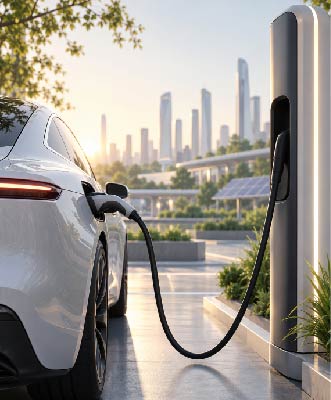
A city can have dozens of charging points and still leave drivers struggling to find the right one at the right time. The future of electric car charging depends on placing the right charging power where people need it, managing peak demand, and building a network that can grow without redesigning the site. Good infrastructure starts with planning, then brings together the right charger capacity, location, and digital management around how the site will actually be used.
The Future of Electric Car Charging as Smart Infrastructure Expands
Think about your own driving. If the car stays parked at home overnight, there is usually no reason to chase the highest charging power available. On a long trip, the priorities change because every extra minute at a stop matters.
That same logic should shape charging infrastructure:
- Home charging for routine overnight use.
- AC charging at offices and destinations where cars remain parked for hours.
- Public charging inside cities for drivers without private charging.
- Fast and ultra-fast DC charging where short stops and high vehicle turnover matter.
The International Energy Agency reported more than 7 million public electric car charging points worldwide by the end of 2025, up more than 33% in one year. Yet charger count alone does not show whether a network is working well.
One commercial site may install more power than it uses for most of the day, while another develops queues at predictable times. Better planning starts with traffic, how long cars are likely to stay, the charging rates those vehicles can use, and the electrical capacity already available.
For a closer look at where each charger type fits, check Electric Vehicle Charging Stations, Their Types and Uses in Homes and Businesses.
Electric Car Charging and the Role of Fast Charging Stations in the Future
If you operate an EV charging site, start with your actual operating needs. Are you serving vehicles that remain parked for several hours, or do you need to move more cars through the site in less time?
At an office building, AC charging can often cover a four- or six-hour stay. On a highway, drivers want enough energy to continue their journey quickly.
Fast DC charging is usually better suited to:
- Highways and service stations.
- Locations with high vehicle turnover.
- Delivery and transport fleets where downtime affects operations.
- Sites serving vehicles that can use higher DC charging rates.
Growing demand does not always mean upgrading every charger. A site may need more charging points first or better power distribution during busy periods. Session volume, parking time, vehicle capability, and site capacity should shape the decision before charger output is selected.
This is an important distinction for electric car charging projects. The highest available kW figure may look attractive, but it only adds value when the location and the vehicles using it can benefit from that power.
For more on matching charging power to actual use, check Electric Car Chargers: A Complete Guide to Choosing the Best Chargers and Achieving Fast, Safe Charging.
How Electric Car Charging Technologies Support Smarter Cities
Picture a site with ten chargers. Several vehicles plug in at once while air conditioning, lighting, and other building loads are also near their peak. Running every charger at full output can create a short but heavy demand spike.
Load management allows available power to be shared between active sessions. Charging output can be reduced temporarily when the building is under heavier load, then increased again when capacity becomes available.
That gives the site more room to work with the electrical infrastructure it already has before deciding that a larger connection is required.
Open standards such as OCPP also connect chargers with a management platform, allowing operators of electric car charging to monitor stations, manage devices, support smart charging, and control parts of the network remotely. The exact functions depend on the protocol version and the platform being used.
For an electric car charging operator, the value appears in everyday tasks:
- See the status of every charging point from one dashboard.
- Track sessions and energy use.
- Spot certain faults before a customer reports them.
- Adjust operating settings remotely.
- Review peak-demand data before adding more chargers.
These tools become more important as a site grows. Managing two chargers manually is very different from managing ten chargers across one location or a network spread across several sites.
For more on this topic, read What Is Open Charge Point Protocol and Why Does It Matter When Choosing an EV Charger?.
Challenges Facing Electric Car Charging Infrastructure
Planning to expand an electric car charging project? Growth affects more than the charger itself. It also changes the demands placed on electrical capacity, cabling, communications, maintenance, and the physical layout of the site.
| Challenge | What it can mean for the project | What to review |
| Electrical capacity | Costly upgrades later | Current load and expected demand |
| Site selection | Low use or repeated congestion | Traffic and parking time |
| Charger output | Higher cost without enough use | Vehicle capability and usage profile |
| Maintenance | Offline chargers and lost sessions | Monitoring and preventive response |
| Digital systems | Harder network management | Compatibility and management platform |
| Expansion | Repeating electrical and civil work | Space, cable routes, panels, and spare capacity |
- Leaving space in the distribution board or planning an additional cable route during construction can be far easier than reopening the site two years later to add four more charging points.
- The budget also extends beyond the charger. Electrical and civil work, available power, connectivity, management systems, and maintenance all affect the final cost.
- Planning these elements early helps avoid a common problem: installing charging equipment that works well today but leaves the project with expensive changes as soon as traffic grows.
For the cost side of planning, check this article: Costto Install EV Charging Station: Factors, Permits, and Long-Term Returns.
The Future of Electric Car Charging Stations as EV Adoption Grows
More EVs on the road do not mean every location needs an ultra-fast charger. What changes first is the range of charging needs.
A driver charging at home wants to recover the energy used during the day before morning. An employee can use several hours parked at work. A long-distance driver values a short stop. A fleet needs charging to fit around departure and return schedules.
The next stage of electric car charging infrastructure will depend heavily on four decisions:
- Match charging power to the location: Use AC where cars stay longer and DC where speed is part of the service.
- Manage available energy: Use existing capacity well before assuming the site needs a larger electrical connection.
- Keep the network visible: Bring charger status, sessions, faults, and operating data into one management environment.
- Plan expansion early: Leave enough electrical and physical room to add charging points without redesigning the site.
Current Power’s services follow the same site-first approach, covering assessment, load calculations, charger selection, electrical preparation, installation, operation, maintenance, load management, and OCPP-based monitoring.
In a nutshell, the future of electric car charging will depend on how well each site is planned before the first charger goes live. The right station serves demand where it exists, uses power that fits the vehicles and the time they spend on site, and remains manageable as traffic changes. Current Power supports EV charging projects from early assessment through installation, operation, digital management, and maintenance.
Contact Current Power to plan a charging system around your site’s current needs while keeping enough room for future growth.
Frequently Asked Questions About Electric Car Charging
A charging station transfers electricity from the supply to the vehicle within the limits of both the charger and the car. Control and protection systems manage the session and monitor safe operation.
AC charging is generally better suited to locations where vehicles can remain parked for several hours. DC charging delivers higher power and becomes more useful where reducing stop time is important.
Charging time depends on battery capacity, the starting charge level, charger power, and the maximum rate the vehicle can accept. AC charging may take several hours, while a suitable DC charger can reduce the stop considerably.
OCPP is an open communication protocol between charging stations and management systems. It supports functions such as remote monitoring, device management, and smart charging, depending on the protocol version and platform in use.