
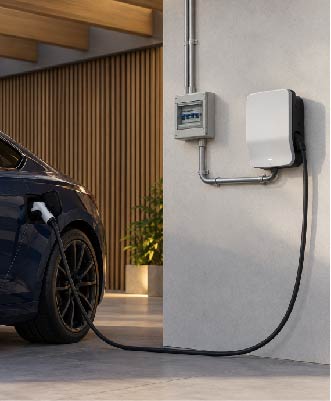
Your home may already be ready for an EV charger with only a dedicated circuit and the right protection. In other cases, the distribution board or available supply needs attention first. That is why home EV charger installation should begin with the property, not with the most powerful wallbox. Available capacity, concurrent household loads, supply type, and distance to the parking space all affect the required work.
Does a Home EV Charger Installation Require Special Electrical Preparation?
A home EV charger installation requires a circuit designed for its load, but that does not mean rewiring the whole house.
Before installation, check:
- Main breaker capacity and existing loads.
- Space for a new circuit in the distribution board.
- Single-phase or three-phase supply.
- Earthing and protection.
- Distance from the panel to the parking space.
- The vehicle’s maximum AC charging rate.
The inspection shows whether the home needs only a dedicated circuit, load management, or an upgrade to the panel or the supply.
How Much Electrical Capacity Does the Home Need?
The useful question is not simply how large the home’s supply is. What matters is how much capacity remains when air conditioning, water heating, cooking equipment, pumps, and other loads are running.
As a guide:
- 7.4 kW: around 32 A on 230 V single-phase.
- 11 kW: around 16 A per phase on three-phase power.
- 22 kW: around 32 A per phase on three-phase power.
A large main breaker does not automatically make a home ready for a high-power charger. Spare capacity during normal use is what matters. Dynamic load management can reduce charging current when household demand rises and increase it again later, avoiding an unnecessary supply upgrade in some homes.
Choosing the Right Power for a Home Charger
- Start with the car.
- If it accepts a maximum of 7.4 kW AC, an 11 or 22 kW wallbox will not make it charge faster. Even an EV that supports 11 kW may not need the full rate if it remains parked overnight.
- Before choosing, check the car’s maximum AC rate, daily energy use, parking time, the possibility of adding another EV, and the spare capacity available at home.
- A home EV charger installation should reflect daily use, not simply the highest charging number available.
Electrical Wiring Required for a Home Charger
- A home EV charger installation should normally have its own circuit from the distribution board rather than share one with other household appliances.
- Cable sizing depends on operating current, cable length, installation method, ambient temperature, indoor or outdoor routing, and voltage drop. The circuit also needs a suitable breaker, residual-current protection, safe routing, and testing before use.
- Two identical chargers can involve very different work depending on the cable route and parking location.
Why Earthing and Electrical Protection Matter
- An EV charger can draw high current for several hours, so the circuit behind it must be designed for continuous use.
- Earthing provides a safe path if a fault occurs, while protective devices disconnect the circuit when overload or leakage current is detected.
- EV charging also needs protection that accounts for possible DC residual current. The correct RCD arrangement depends on the charger and any DC detection already built into it.
Does a Home Charger Need a Separate Meter?
In a standalone home, the existing supply may be enough once the technical requirements are met. A separate meter becomes more relevant when:
- The parking space is shared.
- EV use needs separate measurement.
- Several users need separate billing.
- The approved connection requires separate metering.
Do not add a second meter to the budget until the property actually needs one.
What Affects Home Charger Installation Cost?
Some of the main factors are
- Distance from the panel to the parking space.
- Condition of the distribution board.
- Charger power.
- Cable length and size.
- Outdoor conduit or trenching.
- Breakers and protection.
- Load-management equipment.
- Any required supply upgrade.
A site survey before purchase gives a more realistic figure because some homes need only limited work, while others require panel changes or longer cable routes.
Choosing a Charger That Matches the Home
- The right charger requires matching both the vehicle and the property.
- If spare capacity is limited, look for adjustable current or dynamic load balancing. If the vehicle accepts no more than 11 kW AC, there is little value in making 22 kW the main buying criterion.
Tesla owners can also read Current Power’s guide: How to Keep Your Vehicle Battery Warranty When Using a Tesla Home Charger.
Can You Run a 7, 11, or 22 kW Charger at Home?
Short answer: Yes, if the home has the right supply and the car can use that power.
| Charger | Typical supply | Approx. current |
| 7.4 kW | 230 V single-phase | 32 A |
| 11 kW | 400 V three-phase | 16 A per phase |
| 22 kW | 400 V three-phase | 32 A per phase |
For many drivers, 7.4 kW is enough overnight. An 11 kW unit suits homes and vehicles that support three-phase charging, while 22 kW only adds value when the car can accept it.
For more on the subject, check this article:Electric Vehicle Charging Stations, Their Types and Uses in Homes and Businesses.
How an EV Charger Affects Household Electricity Use
- Home EV charger installation increases household electricity use because the battery now draws energy from the home supply. Charger power, however, is not the same as total energy consumption.
- If the battery needs around 40 kWh, roughly that amount still needs to be supplied whether charging takes place at 7 or 11 kW, allowing for normal losses.
- Higher charging power mainly changes how quickly that energy is drawn. Scheduling and load management can help when charging overlaps with other large household loads.
In conclusion, home EV charger installation does not automatically mean major electrical work. Some homes only need a dedicated circuit and suitable protection. Others benefit from load management, while certain properties need changes to the panel or supply. Current Power supports residential charging projects with site assessment, load calculations, charger selection, electrical preparation, installation, and testing.
Contact Current Power to assess your home before home EV charger installation and understand what the installation actually requires.
Frequently Asked Questions
Available capacity, the distribution board, earthing, supply type, cable route, and any required changes.
When the existing panel or supply cannot safely support the charger alongside normal household loads.
It reduces charging power when household demand rises and increases it again when capacity becomes available.
The car’s AC charging limit, available household capacity, parking time, and daily energy needs.
Power describes how quickly energy is delivered. Consumption is the amount of energy the battery needs, including normal charging losses.