
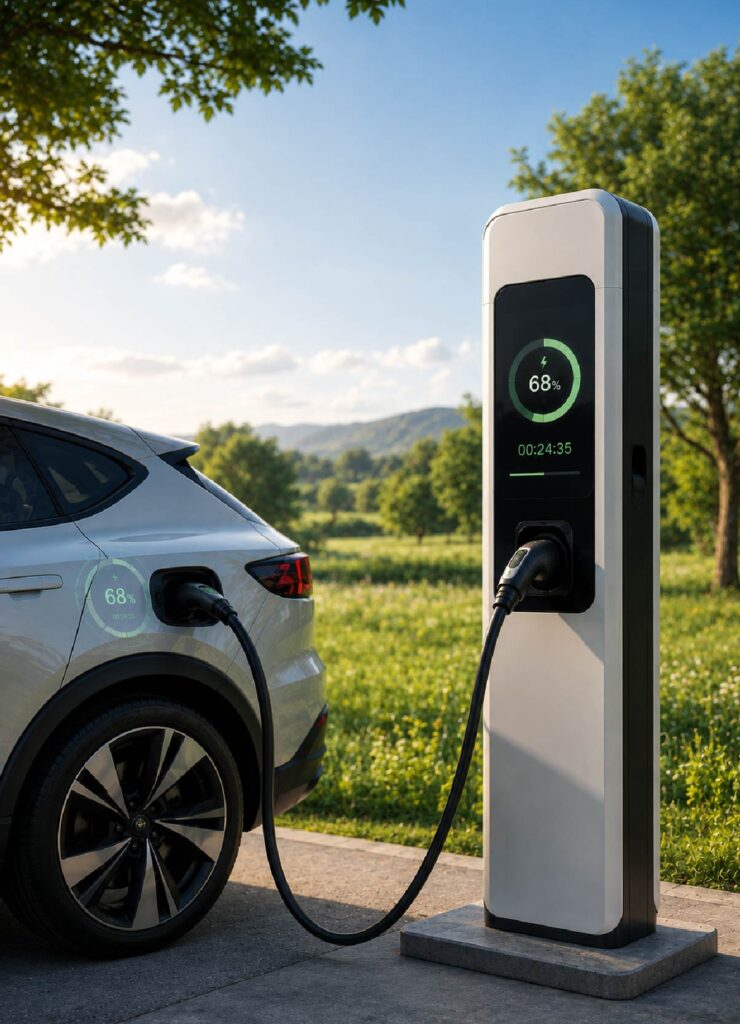
Two EVs can plug into the same charger and still finish at noticeably different times. You may also connect to a high-power fast charger and watch the charging rate drop before the battery is full. That is because electric vehicle charging time depends on much more than the number shown on the charger.
Battery size, the charge level when you arrive, the power your car can accept, and battery temperature all affect the session. Even a vehicle’s maximum advertised charging rate may only be reached during part of the charge.
This guide looks at what really affects charging time, how home charging compares with fast charging, and why the final part of a session can take longer.
Electric Vehicle Charging Time by Charger Type
- Charger power sets what is available to the car, but it does not determine electric vehicle charging time on its own. If a charging point provides 22 kW while the vehicle accepts a maximum of 11 kW on AC, charging will remain within the car’s 11 kW limit.
- DC charging works differently. Power conversion takes place in the charging station rather than through the vehicle’s onboard AC charger, allowing much higher charging rates and shorter stops.
A simple comparison:
| Charging type | Approximate power | Typical charging time |
| Low-power AC | 2 to 3.7 kW | A full night or longer, depending on the battery |
| Home Wallbox | 7 to 11 kW | Several hours, often suitable for overnight charging |
| Three-phase AC | Up to 22 kW | Shorter if the vehicle supports the same power |
| DC fast charging50 to 150 kW | 50 to 150 kW | Can add a large amount of charge in about 30 to 60 minutes |
| High-power DC | Above 150 kW | Shorter stops for vehicles that support higher |
In an earlier comparison, we looked at a 60 kWh battery that may need around four to eight hours on a 7 to 11 kW home charger. A suitable DC fast charger can bring that time down considerably.
How Battery Capacity Affects Electric Vehicle Charging Time
- The more energy the battery needs, the longer the session takes if charging power stays the same. An 80 kWh battery needs more energy than a 50 kWh battery when both cover the same percentage range.
- Battery size alone, however, does not tell you how long one particular session will take.
- What matters is how much energy is missing when charging begins. A large-battery EV arriving at 70% may finish before a smaller-battery car arriving at 10%.
- A simple way to estimate the required energy is the following:
Battery capacity × the difference between the current and target state of charge.
- If a 60 kWh battery starts at 20% and the target is 80%, around 36 kWh needs to be added in theory.
- Charging power then changes the time. Adding 36 kWh at an average of 10 kW is very different from adding the same energy at 50 or 100 kW.
This is why a claim such as “charges in 30 minutes” only becomes useful when the charging range is clear. There is a significant difference between charging from 10% to 80% and measuring a session over another range.
Factors That Determine EV Charging Speed
The same car can use the same charger on two different days and still see a different charging rate. The charging system responds continuously to the battery and the conditions of each session.
The main factors include the following:
- AC charging limit: The onboard charger sets the maximum AC power the vehicle can use.
- Maximum DC charging rate: A car that accepts 100 kW cannot use the full 300 kW available from a more powerful charger.
- Starting charge level: Many EVs accept higher power at lower battery levels, then reduce it as the battery fills.
- Charging curve: The maximum figure published by the manufacturer is a peak, not necessarily the rate maintained throughout the session.
- Battery temperature: Very low or high temperatures can cause the vehicle to reduce charging power.
- Battery preconditioning: Some EVs can prepare the battery temperature before reaching a fast charger.
- Available station power: At sites where several charging points share capacity, the power available to one vehicle may change as other sessions start or finish.
These factors explain why electric vehicle charging time can vary even when the same charger is used.
To learn more about charger power levels, read Electric Vehicle Chargers and the Difference Between Slow, Fast, and Ultra-Fast Charging.
The Difference Between Home Charging Time and Fast Charging
- If your car will stay at home from evening until morning, a short charging session is not necessarily the priority. What matters is having the energy you need before the next trip. A Wallbox fits this routine well because the hours when the car is already parked become charging time.
- Travel changes the calculation. A long charging stop adds time to the journey, so DC charging becomes more useful when the driver wants to recover a good amount of energy and continue without spending hours at the station.
- Reaching 100% is not always the quickest option either. In many EVs, charging power starts to fall as the battery fills, which means the final part of the session may take longer while adding a relatively small amount of energy.
- For many journeys, reaching 70% or 80% may be enough, particularly when that charge covers the remaining distance or comfortably gets the driver to the next charging stop.
For more on choosing between the two, read: Home EV Charging vs Public Charging Stations: Which Is More Efficient and Cost-Effective?
How to Reduce Electric Vehicle Charging Time
Reducing electric vehicle charging time does not always mean buying the most powerful charger available. Start by identifying what is limiting your car.
- Check the vehicle first: Know its maximum AC and DC charging rates before choosing a charger.
- Use suitable home charging power: If the car supports 11 kW and the electrical installation can provide it safely, using a much lower-power charger will make the session unnecessarily longer.
- Choose the right DC charger when traveling: Match the charging station to the highest rate your car can actually use instead of choosing one simply because it displays a larger number.
- Fast-charge at a suitable battery level: EVs often accept higher power when the battery is less full.
- Use battery preconditioning when available: Follow the manufacturer’s instructions before reaching a fast charger.
- Do not wait for 100% at every fast-charging stop: Charge enough to reach your destination or the next planned charging point.
- Watch the actual charging rate: If your car repeatedly charges much slower than normal, check whether the cause is the battery, the charger, or the operating conditions.
In a nutshell, electric vehicle charging time is shaped by the amount of energy the battery needs, charger power, the vehicle’s charging limit, state of charge, and battery condition during the session. A useful estimate therefore starts with the car and the way it is used, rather than relying on the maximum number printed on the charger. Current Power provides home, commercial, and fast-charging solutions, including site assessment, charger selection, and electrical infrastructure preparation based on the vehicle and its actual charging requirements.
Contact Current Power to choose a charging system that fits your vehicle and site and makes better use of the available power.
FAQs About Electric Vehicle Charging Time
Calculate how much energy needs to be added to the battery, then compare it with the average charging power. The result remains approximate because the actual rate can change during the session.
The battery management system gradually reduces charging power at higher charge levels to manage battery conditions and temperature. This is why reaching 100% usually takes longer than the earlier part of the session.
A larger battery needs more energy when the charging power and percentage range are the same. The battery level at the start of the session can still make a major difference to the actual charging time.
The limit may come from the vehicle itself, the battery’s state of charge, its temperature, the charging curve, or the power actually available at the station.